

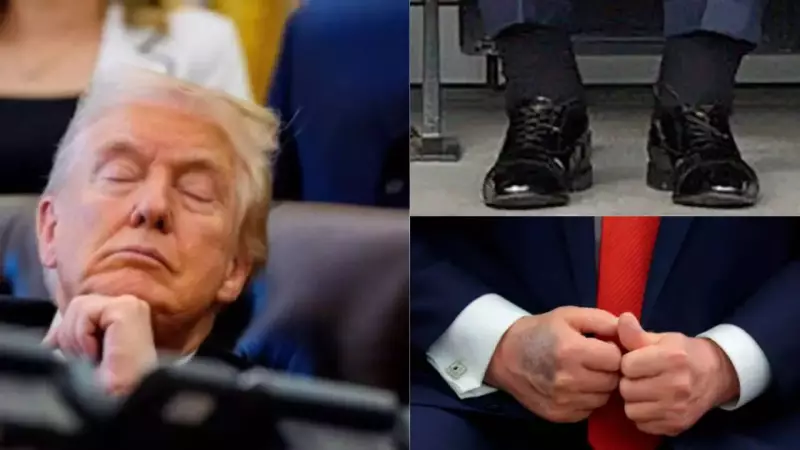
For months, the physical condition of former US President Donald Trump has been a subject of intense public and media examination. Observers have pointed to a noticeable limp in his left leg, episodes of swollen ankles, dark bruises on his hands, and instances where he seemed to doze off during meetings. Each time, his team, led by White House Press Secretary Karoline Leavitt, has attempted to dismiss concerns, though their explanations often sparked further questions.
The Medical Imaging Mystery: MRI or CT Scan?
When scrutiny intensified last October, Trump underwent a medical check-up at the Walter Reed National Military Medical Center that included advanced imaging. Initially, the narrative was straightforward. Trump himself told reporters he had an MRI, stating the results were "perfect." However, in a recent interview with The Wall Street Journal, he contradicted that claim, insisting, "It wasn’t an MRI. It was less than that. It was a scan."
His physician, Navy Capt. Dr. Sean Barbabella, clarified the discrepancy to the same publication. He confirmed that Trump had actually received a CT scan, not an MRI. A CT scan is faster and more common, while an MRI provides more detailed soft tissue images but takes longer. Dr. Barbabella explained that doctors had presented both options and opted for the CT scan to definitively rule out any cardiovascular issues, with results showing no abnormalities.

Following the October check-up, both Barbabella and Leavitt had vaguely referred to the procedure as "advanced imaging." The specific details only emerged later, revealing the confusion between the two types of scans.
Ongoing Health Questions and the Aspirin Link
Since returning to the White House in January, health-related inquiries have persisted. In July, Trump was diagnosed with a chronic venous condition after his swollen ankles drew attention. Another recurring point of discussion has been the dark bruise frequently seen on the back of his hand.
While Leavitt initially attributed the bruising to frequent handshaking, Trump offered a different explanation tied to his medication. He revealed to the Wall Street Journal that he takes a daily dose of 325 milligrams of aspirin, admitting it is higher than typically recommended. "They say aspirin is good for thinning out the blood, and I don’t want thick blood pouring through my heart," Trump stated, adding he has been on this regimen for about 25 years and is "a little superstitious" about it.
Medical experts note that aspirin is a blood thinner, which can reduce the risk of heart attacks and strokes by preventing clots. A key side effect, however, is increased bleeding tendency and easier bruising. The Mayo Clinic indicates that a low-dose aspirin typically ranges from 75 to 100 mg, with 81 mg being most common, though therapy can extend up to 325 mg. Dr. Barbabella confirmed the 325 mg daily dosage.
Reflections and Political Ammunition
Looking back, Trump expressed regret about undergoing the scan at all, viewing it as providing political fodder to his critics. "In retrospect, it’s too bad I took it because it gave them a little ammunition," he told the Journal. "I would have been a lot better off if they didn’t, because the fact that I took it said, ‘Oh gee, is something wrong?’ Well, nothing’s wrong."
The series of statements from Trump and his aides—from the scan confusion to the explanations for bruising—highlight how personal health matters can become intertwined with political narrative, especially for a figure constantly in the global spotlight. The White House has not clarified why the initial MRI claim was not corrected sooner.






