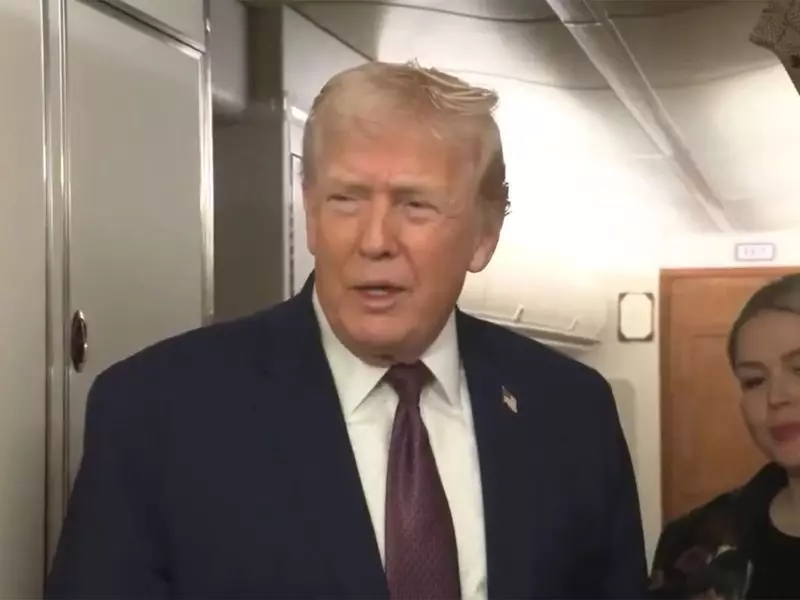
Former United States President Donald Trump has issued a stark and severe warning to Iran, declaring that the Islamic Republic would face a devastating and unprecedented military response if it ever targeted American bases or assets. This statement comes alongside his claim that Iranian leadership is actively seeking to negotiate with the US.
Trump's Unprecedented Threat of Retaliation
Speaking at a campaign event, the former president and current presidential candidate left no room for ambiguity regarding his stance on potential Iranian aggression. Donald Trump explicitly stated that if Iran were to attack any US base, the American response would be of a magnitude never before experienced by Tehran. He used characteristically blunt language, vowing to "hit them like they've never been hit before." This threat underscores the continued hardline posture Trump maintains towards Iran, a consistent feature of his previous term in office.
Trump's warning appears to be a pre-emptive deterrent, aimed at discouraging any hostile actions by Iran or its proxy forces across the Middle East. The context of rising regional tensions, particularly involving groups backed by Iran, makes this public declaration a significant geopolitical signal. The former president framed the potential US retaliation not as a proportional response but as an overwhelming force designed to decisively neutralize the threat.

Claims of Iranian Desire to Negotiate
In a parallel and seemingly contradictory claim, Donald Trump also asserted that the Iranian government is keen to engage in negotiations with the United States. He suggested that Iran is currently "calling to negotiate," indicating a perceived weakness or desperation on their part. This claim has not been independently verified by other sources or the current Biden administration.
This narrative aligns with Trump's frequent portrayal of his "maximum pressure" campaign during his presidency as a successful strategy that brought adversaries to the table. He has often cited the unilateral withdrawal from the Iran nuclear deal (JCPOA) and the imposition of crushing sanctions as policies that forced Iran into a weaker position. However, critics argue that these actions led to increased uranium enrichment and heightened regional instability.
Regional Context and Implications
The warning from the former commander-in-chief carries weight due to the volatile security situation in the Middle East. American troops stationed in Iraq and Syria have faced repeated drone and rocket attacks from Iran-aligned militias. Furthermore, the ongoing conflict and humanitarian crisis in Gaza have raised fears of a wider regional war, potentially drawing in Iran directly or through its proxy network, including Hezbollah in Lebanon and the Houthis in Yemen.
Trump's statement is likely intended for multiple audiences: to reassure American allies of a tough stance under a potential future Trump administration, to warn Iran against escalating hostilities, and to bolster his domestic political image as a decisive leader on foreign policy. The direct nature of the threat marks a continuation of his unconventional diplomatic approach, which often relies on public statements and escalatory rhetoric.
The international community, particularly countries in Europe and the Gulf, will be watching closely. Such explicit threats can alter risk calculations for all actors in the region. The current US administration, led by President Joe Biden, has pursued a different path, attempting a return to diplomacy with Iran while also responding forcefully to attacks on US personnel. Trump's comments highlight the starkly divergent foreign policy directions that could be on offer for the American electorate in the upcoming presidential election.