In a recent interview that has reignited global focus on a longstanding geopolitical fault line, former and potential future US President Donald Trump addressed the prospect of a Chinese military move against Taiwan. Speaking to The New York Times, Trump characterized China's claim on the self-ruled island as "a source of pride" for Chinese leader Xi Jinping.
While expressing his hope that Beijing would not act, Trump notably stated, "I would be very unhappy if he did that." This comment comes against a backdrop of heightened Chinese military assertiveness, including large-scale drills around Taiwan in late December 2025, which Beijing linked directly to US arms sales to the island.
The Deep-Rooted History of US-Taiwan Ties
The complex relationship between the United States and Taiwan is not a contemporary creation but is deeply rooted in the aftermath of World War II and the Cold War. The current standoff traces back to 1949, when the Chinese Civil War concluded with Communist forces establishing the People's Republic of China (PRC) on the mainland. The defeated Nationalists retreated to Taiwan, setting up a rival government.

For decades, the US recognized the Taiwan-based Republic of China as the legitimate government of all China. However, a seismic shift began under President Richard Nixon. Seeing an opportunity to gain leverage against the Soviet Union after the Sino-Soviet split, Nixon initiated a historic rapprochement with Beijing.
The pivotal moment was the secret 1971 mission by US Secretary of State Henry Kissinger, facilitated by Pakistan and Eastern European nations. This led to Nixon's 1972 visit and the Shanghai Communique, where the US first acknowledged the Chinese position that Taiwan was part of China. In his memoir, Kissinger framed the stark choice: the 17 million people on Taiwan versus the 800 million on the mainland.
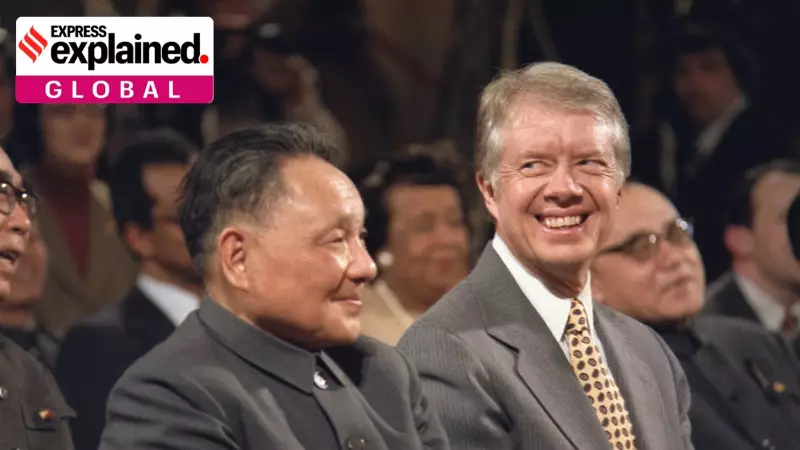
Full diplomatic normalization came in 1979 under President Jimmy Carter, who formally recognized the PRC as China's sole legal government, severing official ties with Taipei. This framework was built on the Three Communiques, wherein the US subscribed to a "One China Policy." A critical nuance persists: China insists on the "One China Principle" (Taiwan is an inalienable part of China), while the US policy merely acknowledges Beijing's claim without necessarily endorsing it. This allows Washington to maintain "strategic ambiguity" regarding its response to a potential attack.
Why Taiwan is a Geopolitical and Economic Linchpin
Taiwan's significance to US interests is multifaceted, spanning strategy, geography, and the global economy.
Geostrategic Dominance: Taiwan sits at the heart of the First Island Chain, a string of US allies including Japan, the Philippines, and South Korea. This chain is crucial for American power projection in the Western Pacific and is seen as a barrier to contain China's military reach. Control of Taiwan would allow China to break through this chain and project power directly into the Pacific.
The Vital Sea Lane: The Taiwan Strait is one of the world's most critical maritime corridors. Nearly half of the global container fleet transits through these waters, carrying an estimated $2.45 trillion in trade annually. It accounts for about 20% of all maritime trade, vital for economies like Japan and South Korea. A Chinese blockade or control of this route would disrupt global commerce catastrophically.
The Semiconductor Chokehold: A $10 Trillion Risk
Perhaps the most tangible global concern is Taiwan's dominance in semiconductor manufacturing. The island produces 68% of the world's semiconductors and over 90% of the most advanced chips, primarily through the Taiwan Semiconductor Manufacturing Company (TSMC).
These chips are the brains of modern technology, powering everything from smartphones and cars to advanced weapons systems. A major conflict disrupting this supply would trigger an instant global economic crisis. Bloomberg Economics estimates a war over Taiwan could wipe out $10 trillion from the world economy—roughly 10% of global GDP—an impact far exceeding that of the COVID-19 pandemic.

Under President Xi Jinping, the rhetoric and pressure for "reunification" have intensified. With the US approving an $11 billion weapons package for Taiwan recently and conducting its own naval transits, tensions remain high. The world now watches how an unpredictable US foreign policy under a potential second Trump administration would respond to a crisis, testing the delicate balance of a decades-old policy that has kept the peace—so far.