UK Government Branding Change Ignites Political Firestorm Over Constitutional Traditions
A significant political controversy has erupted in the United Kingdom following the Labour government's decision to adopt "UK Government" as the primary branding for public-facing communications, replacing the long-standing "HM Government," which stands for "His Majesty's Government." This move has provoked sharp criticism from the Opposition Conservatives, who accuse the government of showing disregard for Britain's constitutional heritage, while the administration defends it as a step toward clearer and more consistent public messaging.
Details of the Branding Shift and Government Justification
Under updated guidance issued after Labour took office in July 2024, official communications are now advised to use "UK Government" as the primary identity in public announcements and branding. Cabinet Office minister Nick Thomas-Symonds explained in a written parliamentary response that this change aligns with updated guidance reflecting the new Royal Coat of Arms following the accession of King Charles III. He stated, "A strategic decision has been made to adopt 'UK Government' as the primary identity for all public-facing communications."
Previously, Government Communications Service guidance under the Conservative administration recommended "HM Government" as the "recognised and trusted" master brand for official communications, unless specific circumstances dictated otherwise. A government spokesperson clarified that the change "does not affect the use of 'His Majesty's Government', which continues on relevant official communications and records," adding that the shift aims to provide greater clarity for the public by emphasizing the government's role in serving the entire country.

Conservative Opposition and Accusations of Disrespect
Conservative leaders have strongly condemned the branding change, labeling it as "disrespectful towards Britain's history, culture, and constitutional settlement." Alex Burghart, the shadow chancellor of the Duchy of Lancaster, accused Labour of attempting to "quietly obliterate tradition," questioning the rationale behind the move. He argued, "What earthly good is caused by this change? It's just another depressing attempt to modernise for modernisation's sake. Be in no doubt: the Conservatives will reverse this on day one."
Other Tory MPs contended that the term "His Majesty's Government" reflects the constitutional principle that ministers serve the Crown, with executive authority exercised in the monarch's name rather than being owned by contemporary politicians. Henry Bolton, a former UKIP leader, escalated the criticism by calling the change "constitutional vandalism" and linking it to broader debates around institutional reforms, such as those concerning jury trials.
Support for the Change and Broader Implications
Supporters of the new branding argue that "UK Government" is clearer and more accessible to the public, better reflecting the government's democratic accountability. Anti-monarchy campaigners have welcomed the move, viewing it as a step toward emphasizing democratic principles over royal symbolism. However, critics perceive the removal of "His Majesty" from public-facing communications as diluting a visible reminder that executive authority is constitutionally delegated by the Crown, potentially undermining traditional symbols.
Historical Context and Constitutional Symbolism
At the core of this controversy is the symbolic significance of the phrase "His Majesty's Government." In the UK's constitutional monarchy, the government formally derives its authority from the sovereign, with ministers appointed by and serving in the monarch's name, even though political power is exercised by elected representatives in Parliament. The term "HM Government" has been used historically in official documentation, alongside institutions like HM Treasury and HM Courts & Tribunals Service.

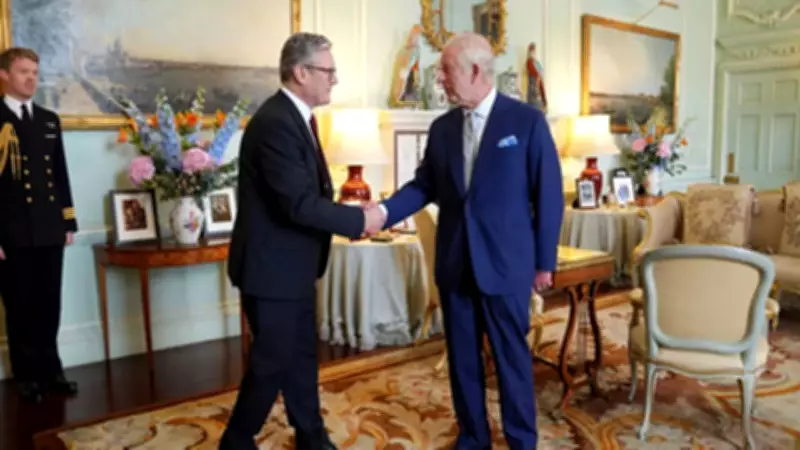
The style "His Majesty" has deep historical roots, dating back to Henry VIII around 1519, when it was adopted to align the English crown with the grandeur of European monarchies. Over time, it became embedded in the legal and constitutional language of the British state. Today, it refers to the reigning monarch, His Majesty King Charles III, who acceded to the throne on September 8, 2022, and was crowned on May 6, 2023, serving as King of the United Kingdom and other Commonwealth realms.
This is not the first instance of Labour facing criticism over changes to royal-linked terminology; during the New Labour era, rebranding of institutions like HM Stationery Office sparked similar debates about modernization versus tradition, highlighting ongoing tensions between evolving public communication needs and preserving constitutional heritage.