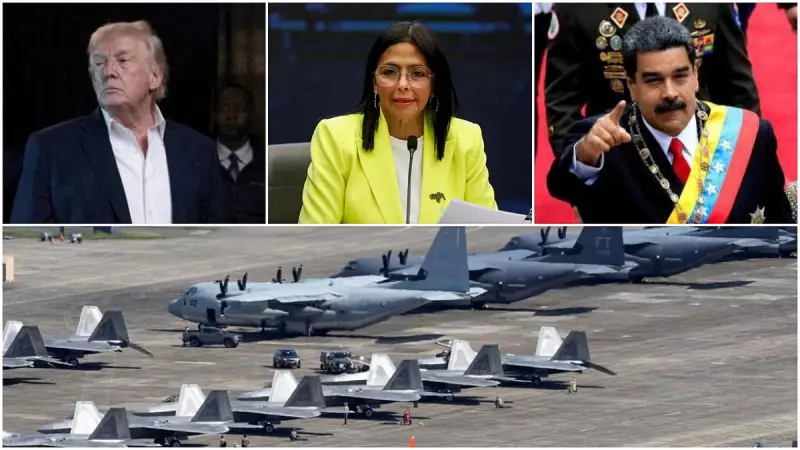
In a significant development in international politics, former US President Donald Trump has publicly declared that the United States is now 'in charge' of Venezuela following the reported exit of Nicolás Maduro. This bold assertion marks a new phase in the long-standing political and economic crisis gripping the Latin American nation.
Rubio Outlines Strategy of Economic Pressure
Elaborating on the administration's stance, US Secretary of State Marco Rubio provided critical details on the planned measures. He stated that the Trump administration intends to maintain a military-enforced "quarantine" on Venezuela's crucial oil exports. This strategy is explicitly designed to exert maximum leverage on the country's emerging leadership, aiming to shape the political transition in Caracas. The move directly targets the nation's primary source of revenue, highlighting the US's hardline approach.
The Context of Maduro's Reported Exit
The dramatic US pronouncement comes amid swirling reports and claims regarding the position of Venezuelan leader Nicolás Maduro. While the original news source references Maduro's 'exit', the precise circumstances and the legitimacy of the new leadership remain focal points of global scrutiny. The power vacuum and the subsequent US intervention underscore the deep geopolitical tensions surrounding Venezuela's vast oil reserves and its strategic importance.

Implications for Global Oil Markets and Diplomacy
This aggressive posture by the United States, dated 05 January 2026, carries profound consequences. The imposition of a military quarantine on oil exports is not just a diplomatic maneuver; it is an act with immediate repercussions for global energy markets. For India, a nation that has historically had energy ties with Venezuela, this development necessitates careful navigation. It presents a complex scenario where energy security interests intersect with the principles of sovereignty and non-interference.
The announcement raises several urgent questions for the international community:
- The reaction of regional powers and global bodies to the US declaring itself 'in charge' of a sovereign state.
- The practical enforcement and legality of a military quarantine on oil shipments in international waters.
- The potential for escalated conflict or a path toward stabilization in Venezuela.
Ultimately, the Trump administration's declaration and the outlined policy of oil containment signal a decisive, unilateral turn in US foreign policy. The world now watches to see how this high-stakes strategy will unfold, reshaping the future of Venezuela and influencing the dynamics of international power.