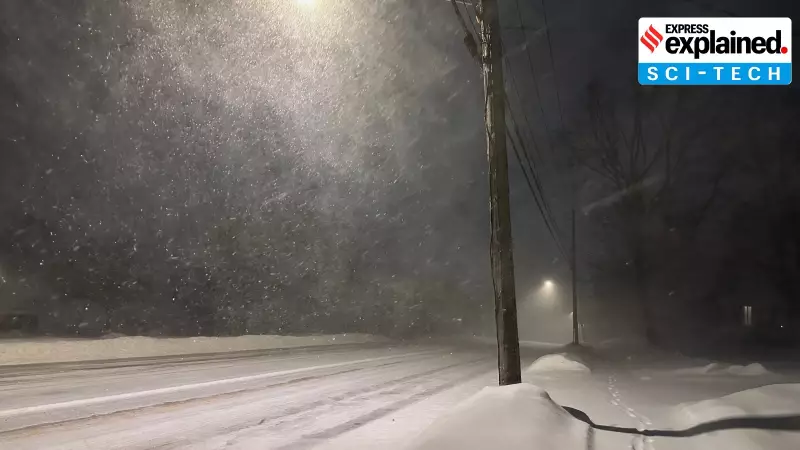
A fierce winter storm, known as a 'bomb cyclone,' unleashed its fury across the northern United States on Monday, December 29, creating treacherous conditions during the busy holiday travel period. The severe weather system brought blizzards, frigid temperatures, and powerful winds to the Midwest and East Coast.
Widespread Disruption and Damage
The immediate impact of the storm was severe. By Tuesday morning, utility reports indicated that approximately 27,000 customers had lost power. Michigan was the hardest-hit state, accounting for more than one-third of all outages. The travel sector faced massive disruptions, with over 9,000 flights delayed and an additional 889 flights cancelled for routes within, into, or out of the United States.
Meteorologists warned that the storm was likely to intensify in the following days. This rapid strengthening, termed 'bombogenesis,' is fueled by the dramatic clash between frigid air moving south from Canada and warmer air masses from the southern US.

What Exactly is a Bomb Cyclone?
While all storms form from the interaction of high and low-pressure systems, a bomb cyclone is defined by its exceptionally rapid intensification. For a storm to earn this label, the central pressure within the low-pressure system must drop by at least 24 millibars in 24 hours.
This sharp pressure drop dramatically increases the pressure gradient, which in turn generates much stronger winds. "Storms that undergo bombogenesis are among the most violent weather systems," notes a report from AccuWeather. The violently ascending air at the storm's center must be replaced by surrounding air rushing inward at high speed, leading to potential property damage, fallen trees, and widespread power failures.
Why These Storms Are So Dangerous
Bomb cyclones pose a significant threat due to their combination of extreme elements. Winds can accelerate to speeds of up to 80 kilometres per hour, enough to topple trees and damage infrastructure. The storms also produce intense precipitation, including heavy snowfall, leading to blizzard conditions. In some cases, lightning can even occur as the system rapidly intensifies.
Although these storms can occur in any season, they are most frequent during fall and winter. They most commonly originate over the western North Atlantic, where cold continental air from North America collides with the warm air over the ocean. The warm waters of the Gulf Stream can further fuel these developing systems.
Research from Northern Illinois University provides context on their frequency. A 2021 study covering 1979 to 2019 found that roughly 7% of all non-tropical low-pressure systems near North America qualified as bomb cyclones. This translates to an average of about 18 such intense storms occurring each year in the region over that 40-year period.