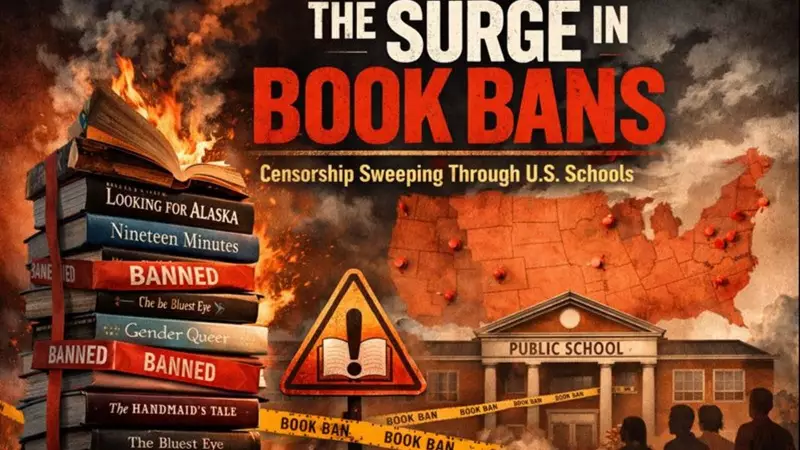
What was once a series of isolated local disputes has transformed into a nationwide crisis of literary censorship in American public schools. Over the past four school years, the removal of books from library shelves and curricula has escalated dramatically, targeting some of the most celebrated works in modern literature.
The Staggering Scale of the Ban Wave
According to data meticulously tracked by the free expression organisation PEN America since 2021, the numbers are alarming. There have been 22,810 documented instances of book removals across 451 public school districts in 45 states. This systematic effort has shifted book banning from a sporadic occurrence to a coordinated national pattern.
Ironically, the books facing the most frequent challenges are often bestsellers and modern classics, pillars of young adult and American literature. John Green's Looking for Alaska tops the list with 147 bans, closely followed by Jodi Picoult's Nineteen Minutes with 142 bans. Both novels grapple with themes of grief, violence, and moral complexity that resonate deeply with adolescent readers.

A troubling trend identified by PEN America is that visibility acts as a magnet for challenges. Once a book is flagged in one district, it often faces repeated removals elsewhere. Popularity on bestseller lists, adoption in classrooms, or traction on social media seems to increase scrutiny rather than offer protection. Authors like Sarah J. Maas and Ellen Hopkins each have seven titles among the top 52 most banned books, indicating that censorship campaigns frequently target an author's entire body of work.
The Real Themes Under Fire: Identity, History, and Truth
While advocates for bans often cite the need to shield students from sexually explicit material, PEN America's analysis reveals a different reality. Many of the most frequently banned books contain little to no sexual content. Instead, the overwhelming majority are targeted for engaging with socially and politically contested themes.
A significant portion of the banned books examines race and systemic racism in America. Foundational works like Toni Morrison's The Bluest Eye and Beloved, Alice Walker's The Color Purple, and Angie Thomas's The Hate U Give confront painful histories of violence, inequality, and marginalisation. Their removal limits students' access to critical dialogues about the nation's past and present.
Similarly, books reflecting LGBTQ+ identities, particularly those of transgender and non-binary individuals, are disproportionately targeted. Memoirs like Maia Kobabe's Gender Queer: A Memoir, George M. Johnson's All Boys Aren't Blue, and Susan Kuklin's Beyond Magenta appear repeatedly in ban counts. PEN America reports that books with transgender characters or authors face some of the highest removal rates, even when written specifically for young adult audiences.
Another large category includes stories that address difficult but real-life issues such as sexual violence, abuse, addiction, and mental health. Laurie Halse Anderson's Speak, Ellen Hopkins's Crank, and Alice Sebold's Lucky provide crucial language and context for experiences that many students unfortunately already encounter.
When Literary Classics Become Classroom Contraband
Perhaps the most paradoxical aspect of this movement is the targeting of books long considered essential to the American literary canon. These are works celebrated globally, taught in universities, and adapted into award-winning films and series.
Margaret Atwood's dystopian masterpiece The Handmaid's Tale, banned more than 100 times, ironically depicts a society where women are forbidden from reading. Judy Blume's groundbreaking 1975 novel Forever…, which offers a frank portrayal of teenage relationships, continues to be challenged nearly five decades later. Maya Angelou's seminal memoir I Know Why the Caged Bird Sings remains a frequent target despite its undisputed status as a cornerstone of American literature.

The removal of these canonical works signals a rapid contraction in what young people are permitted to explore intellectually and emotionally. PEN America warns that the cumulative effect is a severely constrained educational environment. When award-winners and literary classics are deemed inappropriate, the boundary of acceptable reading shrinks dramatically.
The findings, detailed in PEN America's Index of School Book Bans, present a clear conclusion: the books most likely to be removed are often those that ask the most urgent and important questions about society, identity, and human experience. This nationwide trend represents not just fewer books on shelves, but a fundamental narrowing of perspective for a generation of students.