

In a dramatic military escalation, the United States has launched airstrikes in Venezuela's capital, captured its president, and announced plans to seize the country's oil resources, plunging the region into a deep crisis. The pre-dawn operation on Saturday in Caracas has triggered a national emergency, international condemnation, and a dangerous power vacuum.
Operation and Aftermath: Capture, Casualties, and Control
The United States carried out pre-dawn airstrikes across Caracas on Saturday, hitting what reports describe as both military and civilian sites. The raid resulted in at least seven explosions and significant casualties. According to Venezuelan and Cuban authorities, the strikes killed at least 56 people. The dead include 24 Venezuelan security officers and 32 Cuban military and police personnel, with additional civilian deaths also reported.
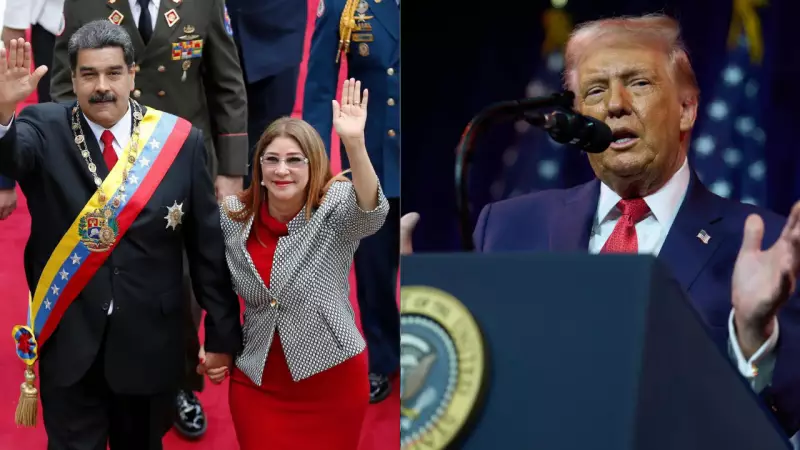
Hours after the assault, US President Donald Trump announced that Venezuelan President Nicolás Maduro and his wife Cilia Flores had been captured by US forces and placed in American custody. They face federal charges in New York, including narco-terrorism and drug trafficking. Maduro appeared in a Manhattan federal courtroom, pleading not guilty and denouncing his capture as unlawful.

In the chaotic aftermath, armed paramilitary groups known as colectivos have been deployed across Caracas. These groups, riding motorcycles and carrying rifles, are manning checkpoints, stopping vehicles, and searching phones to suppress dissent and enforce the interim government's authority, heightening fear among civilians.
US Claims Control and Oil Assets
President Trump declared that the US would temporarily govern Venezuela to oversee a transition. In a highly controversial move, he announced plans for Venezuela to "turn over" between 30 million and 50 million barrels of its crude oil to the United States. Trump directed Energy Secretary Chris Wright to execute the plan "immediately," stating the oil would be sold at market price with proceeds controlled by him to "benefit both Venezuelans and Americans."
Analysts estimate this oil transfer could generate $1.65 to $2.75 billion, though its impact on US fuel prices is expected to be limited. The Trump administration is also pressuring Venezuela's interim government to expel advisers from China, Russia, Iran, and Cuba and to realign its oil partnerships to favor Washington.
Global Condemnation and Mourning
The US operation has sparked fierce international backlash. The United Nations criticized the action, stating it undermines international law by violating Venezuela's territorial integrity and political independence. While acknowledging Maduro's poor human rights record, the UN warned that unilateral intervention could worsen instability.
In response to the lives lost, Venezuela's acting president, Delcy Rodríguez, declared seven days of national mourning for the killed military personnel. Cuba also announced days of mourning for its fallen soldiers. The US military reported that seven American service members were injured during the raid; five have returned to duty while two continue to recover.
This operation marks the most direct US military intervention in Latin America in decades and raises profound questions about sovereignty, international law, and the future of a nation already crippled by years of political and economic turmoil. The situation remains fluid, with Venezuelan state media continuing pro-government broadcasts and the military reportedly maintaining control over key installations.






