In a dramatic pre-dawn operation that stunned the world, United States military forces successfully captured Venezuelan President Nicolas Maduro, ending his nearly 13-year grip on power. The mission, codenamed Operation Absolute Resolve, culminated in the early hours of Saturday, January 3, 2026, after months of secretive planning and a massive military build-up in the Caribbean.
The Final Countdown and a Swift Strike
Despite months of public posturing and a visible military build-up involving warships, jet fighters, and roughly 15,000 troops near Venezuela, the ferocity and speed of the actual attack caught both Washington and Caracas by surprise. President Donald Trump, who had long telegraphed his intentions to remove Maduro, ultimately gave the final green light at 10:46 p.m. on Friday, January 2nd, from a secure facility at his Mar-a-Lago club in Florida.
The operation was a go. Trump's message to military leaders was simple: "Good luck and godspeed." He then watched alongside top aides as approximately 150 warplanes launched from 20 locations across the Western Hemisphere towards the Venezuelan capital.

Residents of Caracas first knew something was amiss just after 1:30 a.m. local time. The roar of aircraft and the sound of explosions shattered the night. Gabriela Márquez, a resident of East Caracas, was awakened by her brother. "They're really bombing," he told her. From her rooftop, she saw a sky filled with the noise of war. "You could only hear explosions," she recalled.
The US deployed overwhelming air power for the mission, including:
- F-18, F-22, and F-35 jet fighters
- EA-18 Growler electronic warfare planes
- B-1 bombers capable of carrying 24 cruise missiles each
- A fleet of remotely piloted drones
Their primary objective, according to Joint Chiefs Chairman General Dan Caine, was to dismantle Venezuela's air-defense systems to ensure safe passage for the extraction helicopters.
The Daring Raid on the Presidential Compound
At 2:01 a.m., a US Special Forces team arrived at Maduro's heavily fortified compound. The helicopters, which had flown as low as 100 feet above the water to avoid detection, came under fire upon approach. American forces responded with what General Caine described as "overwhelming force and self-defense."
Inside the compound, a brief gunfight erupted with Venezuelan security personnel. According to officials, Maduro and his wife, Cilia Flores, attempted to flee into a steel-reinforced safe room but failed to close the door in time. They subsequently "gave up" and were taken into custody by US Justice Department officers.
Denis Esquivel, who lived near the compound, was awakened by the commotion. He noticed the police stationed outside his apartment had vanished. "They ran off and only left behind some shotgun shells," he said. "The only thing I knew was that the palace was in darkness." Trump later confirmed US expertise was used to turn off the lights of Caracas during the attack.
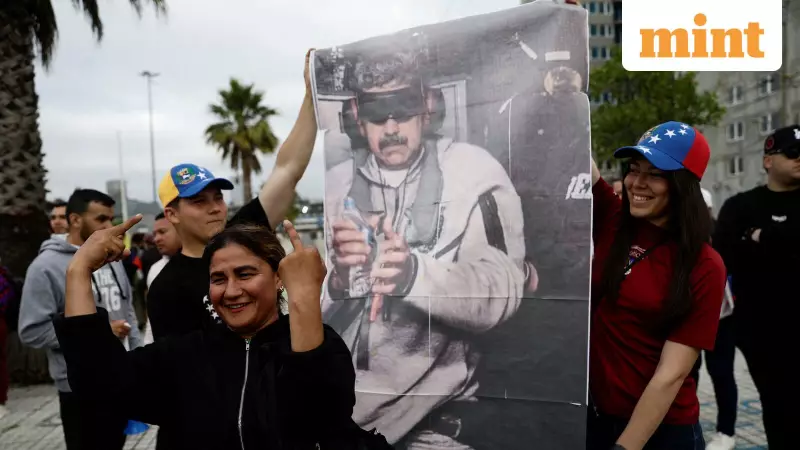
By 3:29 a.m., the captured leader and first lady were aboard a US aircraft, exiting Venezuelan airspace. A photo later released by Trump showed Maduro on the USS Iwo Jima, wearing a grey Nike sweatsuit, dark sunglasses, and what appeared to be handcuffs.
Months of Planning and Political Gambles
The successful raid was the result of meticulous, months-long preparation that began in the late summer of 2025. US intelligence personnel, aided by an asset within Maduro's inner circle, meticulously tracked the Venezuelan leader's habits—what he ate, wore, and where he traveled. Special operations forces repeatedly rehearsed the extraction in a replica of his compound.
Key advisors, including Secretary of State Marco Rubio, Defense Secretary Pete Hegseth, CIA Director John Ratcliffe, and homeland security adviser Stephen Miller, met regularly to plan the mission. However, Trump's circle was deeply divided on the wisdom of a military intervention. Some warned that any mistake could lead to a humiliating failure and that regime change, even framed as a drug crackdown, could anger his conservative base.

Ultimately, Trump concluded that Maduro, who was under US indictment for allegedly facilitating the transport of "thousands of tons of cocaine to the United States," needed to face justice. He insisted on extreme secrecy, limiting knowledge of the plan to a small circle to preserve the element of surprise.
The operation was ready by late December, but Trump waited, hoping Maduro would relinquish power voluntarily. After deeming diplomatic options exhausted, he approved the strike. Earlier attempts on Christmas and New Year's Day were aborted due to bad weather.
Maduro and Flores arrived in New York City on Saturday evening, January 3, 2026. They now face federal narcoterrorism charges in the Southern District of New York and will be held in federal custody during legal proceedings.
Back in Caracas, the dawn brought anxiety and uncertainty. Citizens lined up for food and gasoline, while others stayed indoors, fearful of what comes next. Maria Eugenia Rengifo, jolted awake by the explosions, summed up the mood: "Everything is uncertain now. Like everyone, I'm concerned about the security of my family, above all the children." The United States now faces the complex prospect of overseeing Venezuela during a perilous and unstable transition.