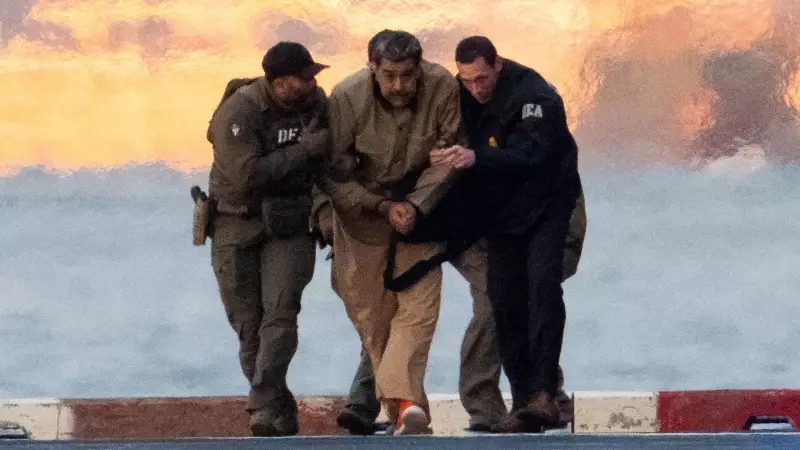
In a dramatic escalation of tensions, the United States military, on January 3, 2026, captured Venezuelan President Nicolás Maduro and his wife, Cilia Flores. The operation, codenamed Operation Absolute Resolve, saw the detained leader flown to New York to face federal charges, with the Trump administration labelling him a "narco-terrorist." This event marks a significant intervention in Latin America, drawing stark parallels with past US operations in nations like Iran, Iraq, and Libya, where control over oil resources played a central role.
The Build-Up to the Capture
The groundwork for this operation began months earlier. In August 2025, a clandestine CIA team infiltrated Venezuela to gather detailed intelligence on Maduro's routines and security, despite the US embassy being shut. Chairman of the Joint Chiefs of Staff, General Dan Caine, confirmed the collection of exceptionally detailed information.
In the interim, the US initiated a military buildup in the Caribbean Sea and conducted over 30 controversial strikes on alleged "drug-boats," reportedly killing over 115 people. By late December, President Trump ordered a quasi-blockade to seize oil tankers moving in and out of Venezuela. The final capture came after Maduro rejected a US offer of asylum in Turkey.

Official Justifications vs. Stated Interests
While the Trump administration has justified Operation Absolute Resolve as a mission against drug trafficking, analysts note that Venezuela is a minor player in the global drug trade compared to other nations. Contradicting earlier assurances to congressional leaders that regime change was not an objective, Trump stated on January 3 that the US would run Venezuela and rebuild its oil infrastructure.
Invoking shades of the Monroe Doctrine, he declared, "American dominance in Western Hemisphere will never be questioned again." Secretary of War Pete Hegseth announced "Southern Spear," the regime change operation. US officials then laid bare their economic interests. Homeland security advisor Stephen Miller claimed Venezuela's oil industry was "the largest recorded theft of American wealth and property."
US Southern Command chief, General Laura Richardson, listed the Lithium Triangle (Argentina, Bolivia, Chile), Venezuela's gold and oil, Guyana's crude, and 31% of the world's fresh water as direct "national security" interests. Notably, the rhetoric lacked any mention of democracy or human rights.
The Real Motive: Oil and the Petro-Dollar System
The core reason behind Maduro's deposition lies in oil and petro-dollars. Venezuela sits on the world's largest proven oil reserves, estimated at 303 billion barrels, surpassing Saudi Arabia (267 BB), Iran (209 BB), and Iraq (145 BB). This vast resource became a direct threat to US economic hegemony.
The current global financial order hinges on the petro-dollar system, established in 1974 when the US secured a deal with Saudi Arabia to price oil exclusively in US dollars. This creates artificial global demand for the dollar, allowing the US to sustain deficit spending and maintain dominance.
However, in 2018, Venezuela moved to "free itself from the US$" by selling its oil for Yuan, Euros, and Rubles. It also petitioned to join BRICS, which is building alternative payment systems, and began direct payment channels with China, bypassing the SWIFT network. Venezuela's massive oil reserves had the potential to fund de-dollarisation for decades, prompting a decisive US intervention to control the spigot and deter other nations from following suit.
A Familiar Playbook: Iran, Iraq, Libya
This operation follows a historical pattern. In 1953, the CIA orchestrated Operation Ajax to overthrow Iran's democratically elected Prime Minister Mohammad Mosaddegh after he nationalised the Iranian oil industry. In 2003, the US invaded Iraq shortly after Saddam Hussein announced he would sell oil in Euros instead of dollars; no WMDs were ever found. In 2011, a NATO-led intervention in Libya culminated in the killing of Muammar Gaddafi, who had proposed a gold-backed African dinar for oil trade.

The aftermath in Venezuela saw its apex court direct Vice-President Delcy Rodríguez to assume the role of Acting President. She called Maduro the rightful leader and demanded his release, prompting a threat from Trump. The US operation, conducted without Congressional approval and labelled a "legal, law enforcement operation," raises serious questions about international law. Stripped of diplomatic language, it resembles a mafia-style abduction, setting a new low for a nation that frequently lectures others on rules-based orders.
Ultimately, Operation Absolute Resolve is less about narcotics and more about securing the lifeblood of the petro-dollar system and reasserting control over the Western Hemisphere's resources, continuing a long-established tradition of realpolitik where oil interests dictate foreign policy.