

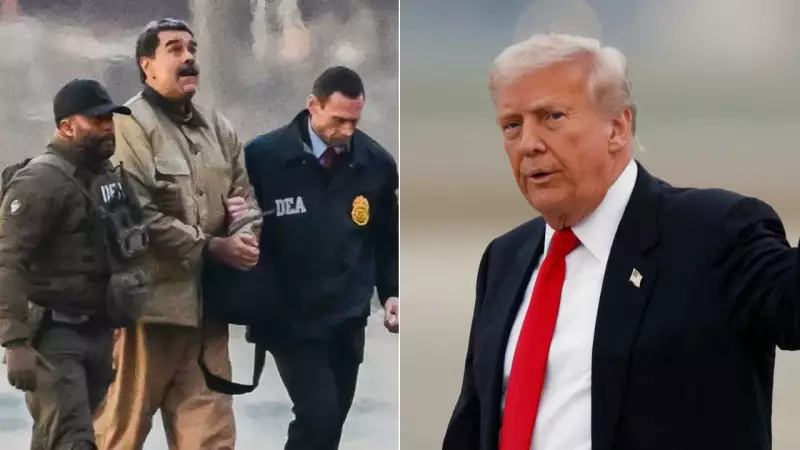
In a dramatic escalation of tensions, United States forces have captured Venezuelan President Nicolás Maduro following a large-scale military operation. The raid, which involved strikes on Caracas and led to Maduro's arrest, has triggered an international crisis and an emergency meeting of the UN Security Council.
Operation and Immediate Aftermath
US President Donald Trump confirmed on Saturday that American forces carried out military strikes against Venezuela and apprehended President Nicolás Maduro and his wife, Cilia Flores. The couple were taken into custody aboard a US warship and transported to New York to face prosecution. The US Justice Department had previously indicted Maduro on charges related to narco-terrorism and drug trafficking.
The operation began in the early hours of Saturday with a series of powerful explosions rocking Venezuela’s capital, Caracas. At least seven blasts were reported near key military installations, accompanied by air raid sirens and low-flying aircraft. Parts of the city were plunged into darkness, causing widespread panic among residents.

Venezuelan authorities declared a national emergency, accusing the US of launching coordinated strikes on both military and civilian targets. Communications were disrupted in several areas as security forces were placed on maximum alert.
Global Reaction and UN Emergency Meeting
The action prompted an emergency session of the UN Security Council on Monday, where both allies and adversaries of the United States voiced strong criticism. UN Secretary-General Antonio Guterres expressed deep concern that rules of international law were not respected, warning the episode sets a dangerous precedent.
US envoy Mike Waltz defended the raid as a "surgical law enforcement action," labelling Maduro an "illegitimate narco-terrorist." He argued the US was acting on a pre-existing indictment and had tried other diplomatic means to remove Maduro.
However, the justification found little support. Russia and China, permanent council members, accused Washington of pushing the world toward an "era of lawlessness." France cautioned that such actions by permanent members undermine the international order. Denmark, a NATO ally, indirectly rebuked the US by defending Venezuela's sovereignty and the inviolability of borders.
Venezuela’s ambassador, Samuel Moncada, urged the council to demand Maduro's release, stating that tolerating the "kidnapping of a head of state" sends a devastating message that force, not law, governs international relations.
Political Shifts in Venezuela and US Stance
In the wake of Maduro's capture, Venezuelan Vice President Delcy Rodriguez was sworn in as the country's acting president. The ceremony was attended by ambassadors from China, Russia, and Iran, all close allies of the Maduro government who condemned the US operation.
Meanwhile, President Trump indicated that Venezuela would not hold elections for at least 30 days, stating the country needed to be "fixed" and "nursed back to health" first. This, coupled with the US decision to keep key figures of Maduro's administration in place, suggests Washington may be prioritising stability over an immediate democratic transition, according to analysts.
Mexico Downplays Threat of Similar US Action
Following the Venezuela operation, attention turned to Mexico, which has also faced threats of US military intervention from President Trump over drug cartel issues. Mexican President Claudia Sheinbaum dismissed the likelihood of unilateral US military action, citing strong bilateral coordination and vital economic ties.
Analysts in Mexico view Trump's threats largely as a "negotiation weapon" to extract concessions, especially with the US-Mexico-Canada trade agreement up for revision this year. They note that Mexico is not Venezuela; it is a major US trading partner with a legitimately elected government, making a similar raid far less probable, though not entirely ruled out.
Regional Instability and the Road Ahead
The capture of Maduro marks the peak of months of heightened US military presence in the Caribbean and repeated warnings to Caracas. The event has stoked fears of wider instability across Latin America, with regional governments calling for restraint.

The situation remains fluid, with Maduro having pleaded not guilty in a Manhattan court, and the international community deeply divided over the legality and consequences of the US intervention. The focus now shifts to the legal proceedings in New York and the challenging task of governing a Venezuela in crisis.





