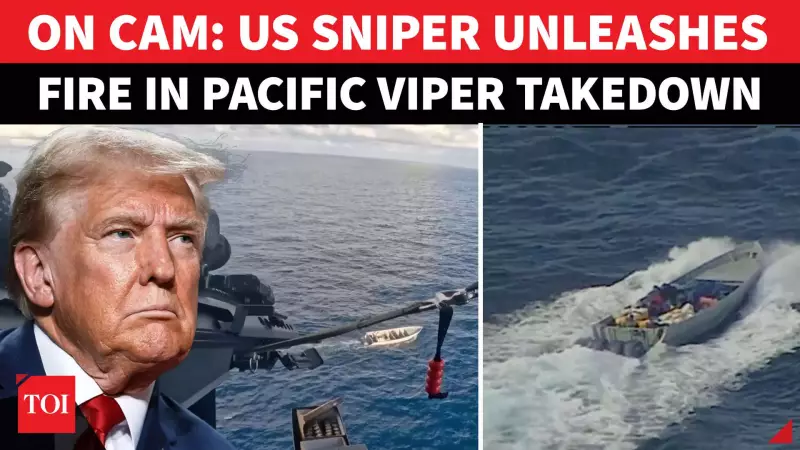
In a dramatic display of maritime law enforcement, the United States Coast Guard successfully intercepted a significant drug smuggling operation, confiscating a massive haul of cocaine. The operation, which took place in international waters, involved a coordinated effort between air and sea assets to stop a high-speed smuggling vessel, commonly known as a 'go-fast' boat.
A Coordinated Strike from Air and Sea
The pivotal moment of the interdiction was captured on video, showing the intense pursuit and final takedown. A US Coast Guard helicopter, operating from the legendary cutter Munro, played a crucial role in tracking and disabling the suspect vessel. The helicopter crew used precise tactics to force the go-fast boat to stop, allowing the cutter's personnel to move in and secure the scene.
Upon boarding the vessel, Coast Guard teams discovered a staggering quantity of illegal narcotics. The seizure amounted to approximately 20,000 pounds of cocaine. This weight is equivalent to roughly 9,000 kilograms, representing one of the substantial hauls intercepted in the region and dealing a severe financial blow to the trafficking network behind it.

The Significance of the Munro and Go-Fast Boats
The USCGC Munro is a renowned national security cutter, named after Coast Guard Medal of Honor recipient Douglas Munro. Its long-range capabilities make it a key asset for conducting complex patrols and interdictions far from the American coastline. The 'go-fast' boat, on the other hand, is a vessel type favored by drug cartels for its speed and agility, designed to outrun conventional law enforcement boats. Successfully countering such a vessel requires advanced planning and superior technology.
This operation underscores the ongoing challenges and sophisticated methods used by international drug trafficking organizations. These groups often use the vast expanse of the ocean to move contraband, exploiting maritime routes to supply markets in North America and beyond.
Impact on International Drug Trafficking
The seizure of 20,000 pounds of cocaine has significant ramifications. Firstly, it prevents a vast quantity of dangerous drugs from reaching streets and communities. The street value of such a haul runs into hundreds of millions of dollars, crippling the economic pipeline of the criminal syndicate involved.
Secondly, the successful mission highlights the critical importance of international cooperation and persistent vigilance in maritime security. The US Coast Guard regularly conducts such operations in collaboration with partner nations to combat transnational crime. This bust serves as a powerful deterrent, signaling to traffickers that their maritime routes are under constant surveillance.
Finally, the operation demonstrates the bravery and skill of the Coast Guard crews who undertake these dangerous missions. Interdicting vessels at sea, often manned by armed smugglers, carries inherent risk, and the successful resolution of this event without major incident is a testament to their training and professionalism.
While the specific location and date of the seizure were detailed in the source footage, the event stands as a recent and potent example of the global fight against the narcotics trade. It reinforces the message that law enforcement agencies remain committed to disrupting supply chains and holding criminal networks accountable on the high seas.