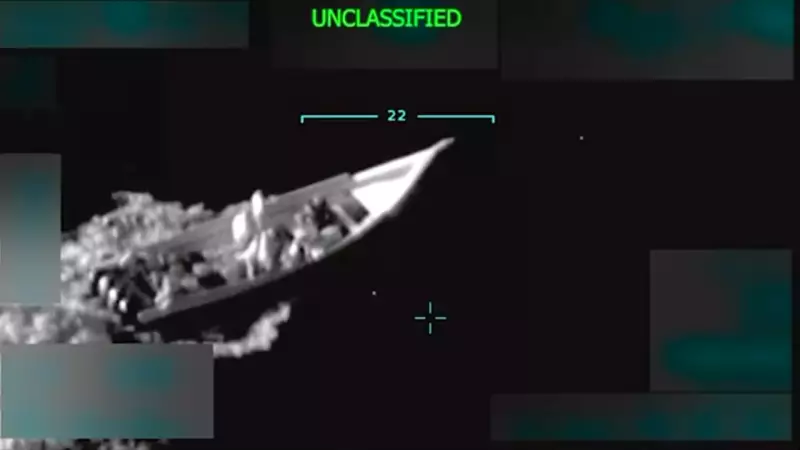
Fresh information has come to light regarding a contentious second United States military airstrike on a suspected narcotics-smuggling vessel on September 2. According to a source familiar with the operation, the two individuals killed in the follow-up attack were assessed as being "still in the fight." This assessment was based on intelligence suggesting they were communicating with nearby boats and attempting to recover drugs from the damaged vessel, as reported by ABC News.
The Rationale Behind the Follow-Up Strike
The initial airstrike on September 2 left two survivors who managed to climb back onto the boat. Military commanders, monitoring the situation, concluded that their actions indicated a continuation of their smuggling mission. Under standing contingency plans developed specifically for counter-cartel operations, this made them legitimate targets. This marked the first instance the U.S. military employed air power against a suspected cartel boat under a new policy framework established by the Trump administration.
The operation's chain of command has been clarified by Defense Secretary Pete Hegseth. He stated that Admiral Frank M. Bradley, who was then leading the Joint Special Operations Command (JSOC), had the operational authority to order the second strike based on prior instructions. Admiral Bradley has since been promoted to commander of U.S. Special Operations Command (SOCOM). Secretary Hegseth noted he watched a live feed of the first strike but did not witness the second, having moved on to another meeting.

Legal Scrutiny and Congressional Concerns
The second strike has sparked significant criticism and legal debate on Capitol Hill. Several U.S. lawmakers have expressed concerns that the action may have violated international humanitarian law. This body of law offers protections to combatants who are shipwrecked, incapacitated, or otherwise out of action. It also encompasses maritime obligations to rescue people in distress at sea.
The Pentagon's contingency plan for such operations explicitly differentiates between survivors. Those who are incapacitated or shipwrecked must be rescued. However, those assessed as still posing a threat—for example, by coordinating with accomplices or engaging in hostile actions—can be targeted. A source told ABC News that a military lawyer was physically present with Admiral Bradley throughout the mission to provide legal guidance, which is standard practice for targeted operations.
President Donald Trump, speaking on Wednesday, said he supported releasing any footage the military possesses of the incident.
Subsequent Operations and Overall Toll
Operations in October demonstrate how the contingency plan is applied in practice. On October 16, two survivors from a targeted semi-submersible were rescued after being determined to be "no longer in the fight." In contrast, on October 27, another survivor was seen swimming after an airstrike off Mexico's coast. The U.S. requested a rescue mission by Mexican authorities, but the individual was never found and is presumed to have drowned.
To date, the U.S. campaign of airstrikes has resulted in a significant toll. 21 separate U.S. airstrikes on suspected drug-smuggling boats in the Caribbean and eastern Pacific have led to 83 confirmed deaths. The new details about the September 2nd strike emerged just ahead of a closed-door briefing to Congress by Admiral Bradley, underscoring the ongoing scrutiny of these aggressive counter-narcotics tactics.