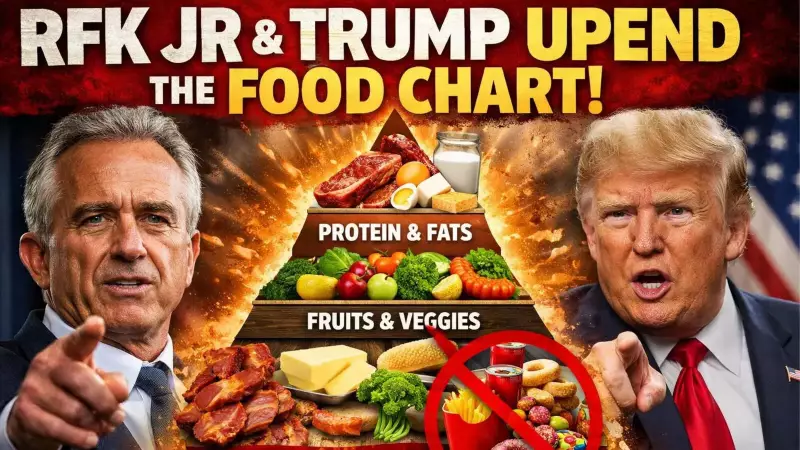
In a landmark move set to reshape nutritional advice for millions, the United States federal government has announced a complete overhaul of its official Dietary Guidelines. The new 2025–2030 guidelines, unveiled on January 7, 2026, represent the most significant shift in US food policy in over four decades.
A Complete Reversal of the Food Pyramid
The familiar MyPlate visual guide, introduced in 2011, has been officially discarded. In its place, policymakers have reintroduced a food pyramid—but one that is fundamentally inverted. This new graphic places protein, dairy, and healthy fats at the foundational top, moving carbohydrates and grains lower down. The change was announced as part of President Donald Trump's "Make America Healthy Again" (MAHA) initiative, spearheaded by Health and Human Services Secretary Robert F Kennedy Jr and Agriculture Secretary Brooke Rollins.
At a briefing, Secretary Kennedy framed this as a necessary reset, arguing that past guidance had marginalised nutrients now deemed essential. "This is how we Make America Healthy Again," he stated, emphasising a return to "real food."

Key Pillars of the New American Diet
The updated guidelines are built on several core principles that mark a sharp break from previous advice. The federal government is now encouraging Americans to:
- Dramatically increase daily protein intake to between 1.2 and 1.6 grams per kilogram of body weight, up from the old baseline of 0.8 grams. For an average adult weighing 68 kg (150 pounds), this means consuming 81 to 109 grams of protein daily.
- Prioritise whole, nutrient-dense foods like vegetables, fruits, legumes, and meats while slashing consumption of ultra-processed foods and refined carbohydrates.
- Choose full-fat dairy and healthy fats from sources like olive oil, nuts, and butter over low-fat alternatives.
- Accept that no amount of added sugar is recommended in a healthy diet.
- Reduce overall alcohol consumption, with specific warnings for pregnant women and other vulnerable groups.
Officials justify this protein-centric approach as a strategy to combat chronic disease. They cite alarming statistics: nearly 70% of US adults are overweight or obese, and about one in three adolescents has prediabetes. The administration estimates that poor diet drives nearly 90% of the nation's healthcare spending.
Controversies and Global Implications
This historic shift has ignited a fierce debate within the global health community. While many applaud the clear stance against ultra-processed foods and added sugars, others express deep concern. Critics, including organisations like the American Heart Association, warn that the emphasis on red meat and saturated fats could elevate cardiovascular risks, contradicting decades of research.
The guidelines have far-reaching consequences beyond individual choices. They directly influence:
- School lunch programs for millions of children.
- Nutritional criteria for food assistance programs like SNAP.
- Dietary counselling in healthcare and military readiness initiatives.
This policy reorientation under the Trump administration, led by RFK Jr., unmistakably resets the nation's nutritional compass. Whether it leads to improved public health outcomes will be closely watched worldwide, as the US Dietary Guidelines often influence dietary trends and discussions far beyond its borders.