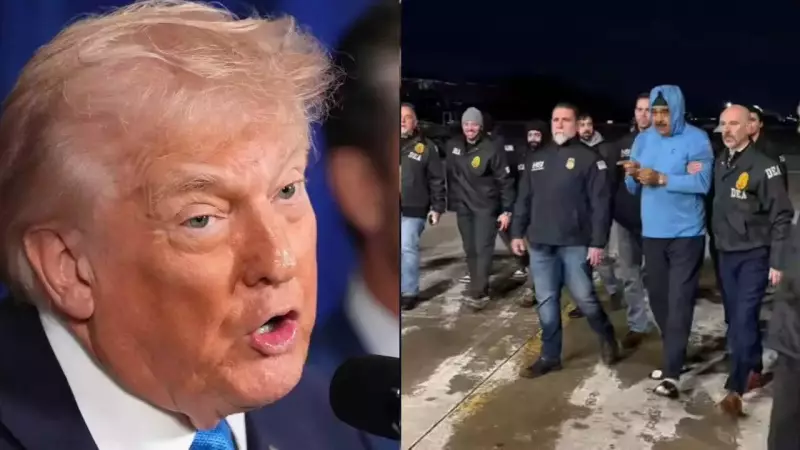
In a dramatic escalation of tensions, United States forces launched a major military operation in Venezuela this Saturday, resulting in the capture of the country's President, Nicolás Maduro, and his wife, Cilia Flores. The pre-dawn attacks on the capital, Caracas, led to significant casualties and threw the city into chaos.
Operation 'Absolute Resolve': The Raid and Its Aftermath
US President Donald Trump announced that the "large-scale strike," codenamed Operation 'Absolute Resolve,' successfully apprehended the Venezuelan leader. The assault, which involved reports of multiple explosions and low-flying aircraft, caused the deaths of at least 40 people and triggered widespread panic across Caracas. Following the incursion, Venezuelan government forces were deployed nationwide, and the country entered a state of national emergency.
President Trump took to his social media platform, Truth Social, to share a photo showing a handcuffed Maduro wearing a blacked-out mask. Trump accused Maduro of running a "narco terrorist organisation." Concurrently, Attorney General Pam Bondi publicised an unsealed indictment from New York charging Maduro and his wife with serious offences, including narco-terrorism, cocaine importation conspiracies, and possession of machine guns. These charges, combined with drug trafficking allegations, carry the potential for severe prison sentences.

A Legal Firestorm: Questioning the Legality of the Strike
The dramatic military action has ignited an intense global debate over its legality under both US and international law. While US Secretary of State Marco Rubio framed the operation as "primarily an act of law enforcement," critics argue that an armed incursion into a sovereign nation without its consent presents profound legal challenges.
International law experts cited by The Guardian were swift to condemn the action. They pointed to Article 2(4) of the UN Charter, which obliges all member states to refrain from the threat or use of force against the territorial integrity or political independence of any state. Geoffrey Robertson KC, a former president of the UN war crimes court for Sierra Leone, labelled the raid "contrary to article 2(4)" and described it as a "crime of aggression… the supreme crime" under international law.
Elvira Domínguez-Redondo, a professor of international law, echoed this sentiment, calling the operation "a crime of aggression and unlawful use of force." Legal scholars noted that such an action could only be justified with authorisation from the UN Security Council or under the principle of self-defence, neither of which appears applicable here. Professor Susan Breau stated there was no clear evidence linking Maduro directly to drug trafficking that posed an imminent threat to US sovereignty, undermining a potential self-defence argument.
Political Repercussions and Calls for Accountability
The operation has also stirred significant political controversy within the United States. Representative Jim Himes, the top Democrat on the House Intelligence Committee, called for the administration to "immediately brief Congress on its plan to ensure stability in the region and its legal justification for this decision."
President Trump, however, dismissed constitutional concerns during an interview on Fox & Friends Weekend, suggesting that Democrats critical of the mission "should say, 'Great job.'" The event marks a unprecedented moment in modern inter-state relations, setting a contentious precedent for cross-border military actions framed as law enforcement. The world now watches closely for Venezuela's next steps and the broader implications for international norms governing sovereignty and the use of force.