

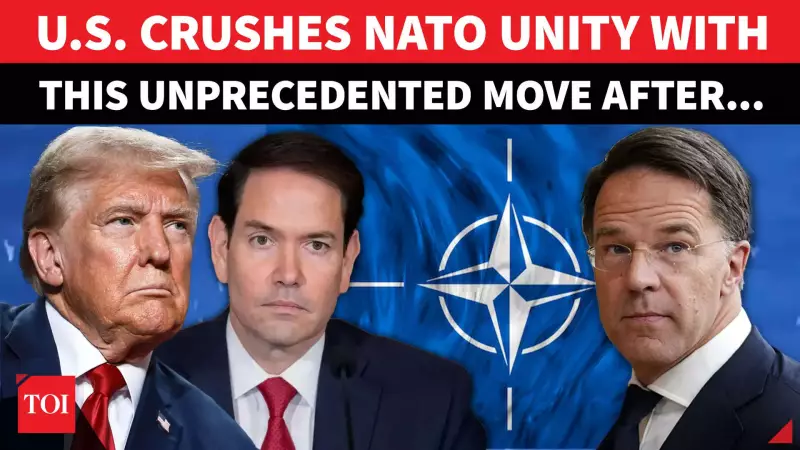
In a significant departure from decades of diplomatic tradition, the United States was absent from a crucial NATO meeting in Brussels this week. This marks the first time since 1999 that a U.S. Secretary of State has not attended such urgent talks with the transatlantic alliance.
A Strategic Shift in U.S. Foreign Policy
Instead of being in Europe, Secretary of State Marco Rubio has been concentrating his efforts on Latin America, with a particular emphasis on Venezuela. His focus has been on regional security and combating what the administration terms narco-terror threats emanating from the region. This move signals a clear strategic pivot under the Trump administration, prioritizing hemispheric concerns over traditional Atlantic alliances.
Rubio's presence at the White House has also increased recently as Congress raises questions about the legality of recent U.S. military strikes. These operations targeted suspected drug-smuggling vessels in international waters, part of a broader crackdown.

Hardline Stance and Regional Pressure
The Secretary of State's hardline stance against Venezuelan leader Nicolás Maduro is a cornerstone of this new approach. The administration is combining direct operations with increased pressure on Venezuela's neighboring countries. The goal is to isolate the Maduro regime and address security threats closer to the U.S. homeland.
However, this reorientation has not come without criticism. Several foreign policy experts and critics within the U.S. warn that sidelining Europe at a critical NATO huddle carries significant risks. They argue it could weaken the alliance's unity and embolden adversaries, primarily Russia, at a time of ongoing global instability.
Implications for Global Alliances
The decision to skip the NATO meeting is being interpreted as more than a simple scheduling conflict. It is seen as a tangible manifestation of the Trump administration's desire to reset relations with Russia and distance Washington from what it sometimes views as an outdated anti-Russia bloc. This stunning potential shift in U.S. policy has caused alarm among European allies who depend on American security guarantees.
The absence underscores a broader debate about America's global role. Is it pulling back from its traditional post-World War II leadership in Europe to focus on what it perceives as more immediate threats in its own hemisphere? The events of this week suggest the answer, for now, may be yes.
As the administration doubles down on its Latin American strategy, the world watches to see how this recalibration will affect long-standing partnerships and the global balance of power. The move has undoubtedly sent a strong message about the current White House's foreign policy priorities.






