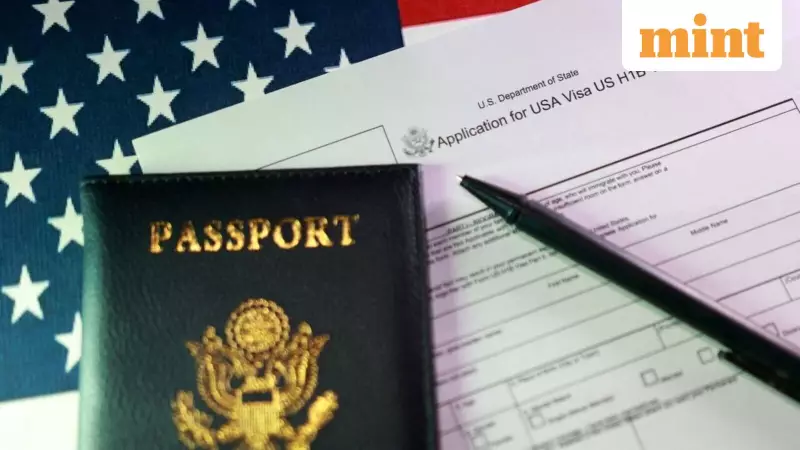
A veteran United States Foreign Service Officer has issued a stark warning about widespread exploitation and fraud within the H-1B visa system, alleging it has become a major conduit for Indian nationals with fraudulent credentials to enter the US, displacing qualified American workers in critical sectors.
An Insider's View: From Chennai Consulate to Global Fraud
The alarming claims come from Officer Mahvash Siddiqui, who has 21 years of experience in national security and visa adjudications. Drawing from her early posting two decades ago, she revealed that even then, 70–90% of visa applicants at the U.S. Consulate in Chennai aimed to exploit non-immigrant visas to live and work in America illegally. Today, the scale has ballooned. She noted that while Chennai processed about 100,000 H-1B petitions annually from 2005 to 2007, demand has now skyrocketed to over 400,000 applications per year.
The core issue, according to Siddiqui, is that H-1B applications arrive at consulates pre-approved by the Department of Homeland Security (DHS), making denials exceptionally rare—around only 2%. Challenging a visa requires extensive legal work, which is nearly impossible for officers processing up to 200 applications daily.

The Industrialised Fraud Machine: Fake Degrees and Complicit Networks
Siddiqui described a well-oiled "industrialised" fraud ecosystem. She highlighted specific markets, like Ameerpet in Hyderabad, where entire shops openly sell fake university degrees, forged bank statements, and counterfeit personal documents. Many applicants claiming computer science degrees could not pass basic coding tests, exposing their lack of genuine qualifications.
The corruption, she alleged, extends to human resources officials both in India and the United States, who collaborate to produce fake employment letters. This enables underqualified candidates to slip through verification cracks. Furthermore, a pervasive 'halo effect' favouring Indian applicants, combined with a cultural normalisation of fraud and instances of bribery, exacerbates the problem. In the US, some Indian managers have created insular hiring networks that deliberately exclude American candidates, she claimed.
Broader Consequences: Beyond IT to Medicine and Education
The impact is not confined to the information technology sector. Siddiqui extended her critique to the medical field, stating that some Indian medical graduates on J-1 visas end up practicing in the US with skill levels below American-trained doctors. The chain often begins with the F-1 student visa, where international students, including those at elite universities, use Optional Practical Training (OPT) as a stepping stone to the H-1B, frequently guided into IT roles by existing ethnic networks.
The ultimate casualty, she emphasized, is the American professional. Rigorously trained US IT and STEM graduates are finding themselves unemployed or forced to train their lower-paid H-1B replacements, a situation she calls a direct displacement of qualified domestic talent.
Six-Point Policy Prescription for Reform
Calling for urgent action, Officer Siddiqui presented a six-point plan for policymakers:
- Pause new H-1B issuances until a comprehensive audit of the program is completed.
- Strengthen vetting with rigorous verification of academic degrees, professional skills, and employment history.
- Prioritise hiring of U.S. STEM graduates in sectors where domestic talent is available.
- Ban nepotistic and chain hiring practices that systematically exclude American workers.
- Enforce strict penalties for fraud, using recent successful prosecutions as a model for deterrence.
- Expand site inspections of companies to match the massive scale and inherent risk of the H-1B program.
Her testimony, reported by the Centre for Immigration Studies, paints a picture of a system in critical need of overhaul to protect its integrity and its original purpose.