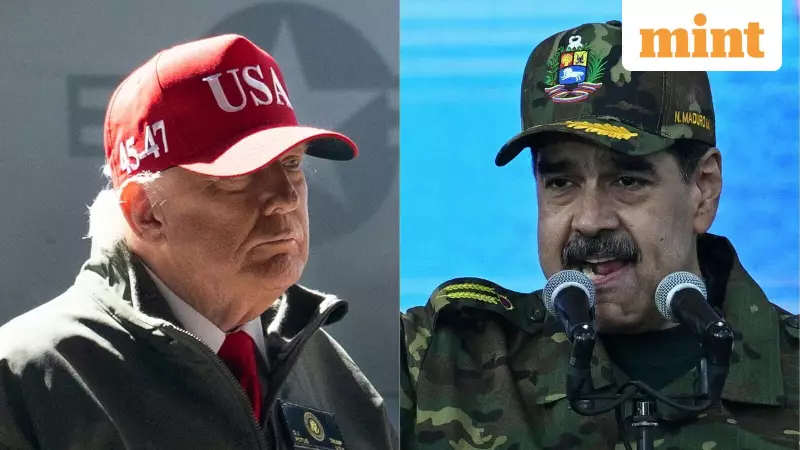
In a dramatic escalation of its campaign against international narcotics trafficking, a United States military strike has resulted in the capture of Venezuelan President Nicolas Maduro and his wife. The operation targeted networks accused of smuggling large quantities of cocaine and fentanyl into the US.
Escalation in Anti-Drug Campaign
Following this controversial intervention, the Trump administration has announced plans to significantly intensify military operations against drug cartels across Latin America. This move marks a new chapter in the complex and often strained relationship between the US and Venezuela, a dynamic historically defined by disputes over oil, political ideology, and regional security.
US officials have long argued that Venezuela's critical oil sector has become deeply entangled in activities aimed at evading sanctions, utilising illicit shipping networks, and fostering broader criminal enterprises. Despite possessing the world's largest proven oil reserves, estimated at a staggering 303 billion barrels (Bbbl) as of 2023, Venezuela today earns only a tiny fraction of the revenue it once generated from crude exports, as reported by Al Jazeera.

The Global Scale of Venezuela's Oil Wealth
Data from the Oil and Gas Journal's 2023 Worldwide Reserves and Production report places Venezuela firmly at the top of global oil holdings. To put this in perspective:
- Saudi Arabia ranks second with reserves of about 267.2 Bbbl.
- Iran follows with 208.6 Bbbl.
- Canada holds 163.6 Bbbl.
Together, these four nations account for more than half of the planet's known oil reserves. In stark contrast, the United States holds approximately 55 Bbbl, placing it ninth globally. This means Venezuela's reserves are more than five times larger than those of Washington.
Globally, proven oil reserves that can be economically extracted with current technology stand at about 1.73 trillion barrels.
The Paradox of Vast Reserves and Meagre Exports
However, Venezuela's immense underground wealth has not translated into proportional export earnings. According to the Observatory of Economic Complexity (OEC), the country's crude oil exports were valued at just $4.05 billion in 2023.
This figure is dwarfed by the export revenues of other major producers:
- Saudi Arabia: $181 billion
- United States: $125 billion
- Russia: $122 billion
While Venezuela also exports smaller volumes of refined products like gasoline and diesel, its potential is severely hampered by ageing refinery infrastructure, persistent technical challenges, and the weight of international sanctions.
Strategic Interest: The Heavy Crude Connection
The recent events bring a sharp focus to Venezuela's energy resources. The United States, while the world's biggest oil producer, primarily yields light crude oil. A significant portion of its refinery infrastructure, particularly along the Gulf Coast in Texas and Louisiana, is specifically configured to process heavier grades of crude.
As reported by Sky News, retrofitting these refineries would require investments of billions of dollars, offering little economic incentive for such upgrades in the near term. Consequently, the US remains heavily reliant on imports to meet its demand for heavy oil. It continues to import over 6,000 barrels of heavy crude per day to feed these specialised refineries, even as it exports much of its own lighter production.
This dynamic underscores the strategic value of Venezuela, which alongside Canada and Russia, sits on some of the planet's most significant reserves of heavy crude oil. This geological fact is a key driver behind the enduring American interest in gaining stable access to Venezuela's oil, a interest now set against the backdrop of a major military and political intervention.