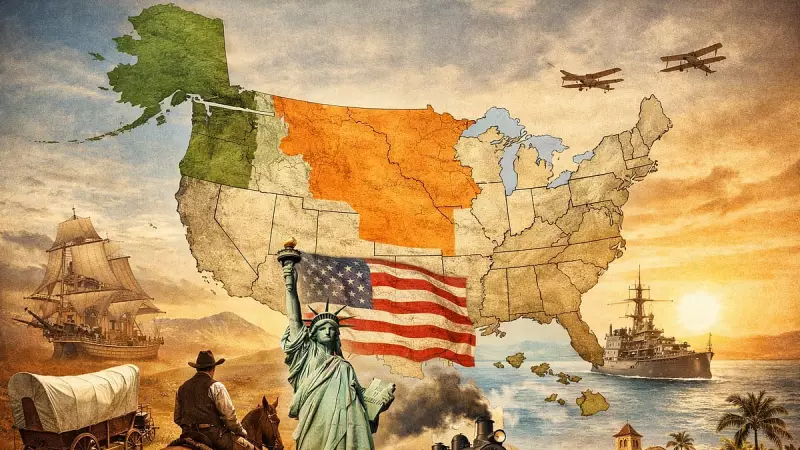
How the United States Built Its Territory: A Chronological Expansion
The map of the United States we recognize today is the result of a series of strategic acquisitions spanning over a century. Driven by a complex mix of security concerns, economic opportunities, and geopolitical rivalries, these territorial expansions fundamentally reshaped the nation's boundaries and its emerging role on the global stage. This chronological list traces the key steps in this monumental nation-building process.
The Early Foundations: Independence and Initial Growth
The journey of American territorial expansion began shortly after the nation's birth. The Treaty of Paris in 1783 formally ended the Revolutionary War, with Great Britain recognizing U.S. independence and ceding territory east of the Mississippi River. This established the initial core of the new republic.
Following this, the Vermont annexation in 1791 marked an early addition, as Vermont joined the Union as the 14th state. However, the most transformative early acquisition was undoubtedly the Louisiana Purchase of 1803. President Thomas Jefferson's administration negotiated this deal with France, effectively doubling the size of the United States overnight for about $15 million. This vast territory opened the continent to westward expansion.

Southern and Western Expansion in the 19th Century
The early 1800s saw further consolidation in the South. The West Florida annexation in 1810 was a disputed move, followed by the more formal Florida acquisition in 1819 through the Adams-Onís Treaty with Spain. This secured the southeastern flank of the nation.
As the century progressed, expansionist fervor, often termed "Manifest Destiny," propelled the nation westward. The Texas annexation in 1845 came after a period of Texan independence from Mexico, leading directly to conflict. Simultaneously, diplomacy resolved northern borders with the Oregon Territory settlement in 1846, establishing the 49th parallel as the boundary with British North America.
The Mexican-American War culminated in the Mexican Cession of 1848, where Mexico ceded a massive swath of land including present-day California, Nevada, Utah, and parts of other states, for $15 million. This completed the contiguous United States from coast to coast.
Overseas and Strategic Acquisitions
Following the Civil War, U.S. expansion turned beyond the North American mainland. Secretary of State William Seward orchestrated the Alaska Purchase in 1867, buying the territory from Russia for $7.2 million—a move initially mocked as "Seward's Folly" but later proven immensely valuable.
The Spanish-American War led to the Hawaii annexation in 1898, formalizing U.S. control over the strategic Pacific islands. The same year, the war also resulted in gaining Puerto Rico, Guam, and the Philippines, signaling America's arrival as a colonial power.
20th Century Strategic Holdings
The new century focused on securing global trade and military routes. The Panama Canal Zone was acquired in 1903 through a treaty with Panama, granting the U.S. control to build and administer the vital canal. That same year, the Guantanamo Bay lease was established with Cuba, creating a permanent naval base.
Later acquisitions were smaller but strategically significant. Water Island was purchased in 1944 to bolster Caribbean defenses. Following World War II, the United States administered the Pacific Trust Territories from 1947 onwards under a UN mandate, including islands like the Marshall Islands and Micronesia, which later gained independence or free association status.
This chronological progression from the Treaty of Paris to the Pacific Trust Territories illustrates a deliberate, often contentious, path to becoming a continental and global power. Each acquisition carried profound implications for domestic politics, indigenous populations, and international relations, weaving the complex tapestry of the modern United States.