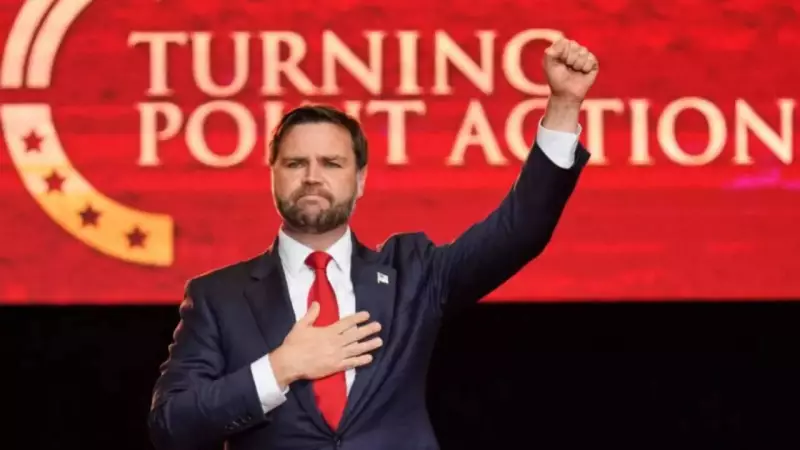
In a speech that blended faith, nationalism, and economic policy, US Vice President JD Vance positioned the reform of the H-1B visa program as a core tenet of what he termed "true Christian politics." Speaking at the Turning Point USA's AmericaFest 2025 conference in Phoenix, the potential 2028 presidential contender argued that economic dignity for American workers is a religious imperative, directly challenging the current high-skilled immigration system.
Vance's Vision: A Christian Nation and Economic Dignity
Vance, in his closing remarks on Sunday, asserted that Christian principles must govern not just social issues but the economic sphere as well. He claimed the H-1B program, which brings tens of thousands of skilled workers—predominantly from India—to the US, undermines this by allowing companies to bypass American labor for cheaper options. "We believe it is wrong for companies to bypass American labour just to go for cheaper options in the third world," Vance stated, drawing loud applause from the conservative audience.
He further ignited controversy by declaring, "The only thing that is truly served as an anchor of the United States of America is that we have been, and by the grace of God, we always will be, a Christian nation." This claim was immediately criticized by commentators and historians who pointed to the US Constitution's lack of such a designation and the founding fathers' explicit belief in the separation of church and state.

The H-1B Visa: Battle Lines Drawn for 2028
Vance's speech highlighted how immigration, specifically the future of the H-1B program, is becoming a defining issue for Republican politics ahead of the 2026 midterms and the 2028 presidential race. His stance, however, is one of reform rather than outright elimination. He pointed to recent Trump administration actions—including a $100,000 fee hike for new H-1B applications and enhanced vetting causing delays for Indian applicants—as steps toward preventing abuse and restoring fairness.
This placed him between two fierce opposing camps within the conservative movement. On one side, figures like Steve Bannon, who spoke earlier at the conference, denounced the H-1B as a "scam" and called for its complete abolition. On the other, proponents of a more tech-friendly, merit-based approach, like entrepreneur Vivek Ramaswamy, argued for attracting the "best and brightest" to compete with China in fields like AI.
Strategic Divisions and Indian Impact
The debate underscores deep divisions within the MAGA movement on immigration and economic nationalism. Vance's reform-focused nationalism creates a sharp contrast with hardliners like Florida Governor Ron DeSantis, who has called for a complete H-1B ban. With over 730,000 H-1B holders, a majority from India, currently in the US, the issue has significant implications for the tech sector and resonates with young American voters concerned about jobs and student debt.
The conference, the first major Turning Point gathering since founder Charlie Kirk's death in September 2025 and led by his widow Erika Kirk, saw the H-1B debate emerge as one of its most contentious issues. As the 2028 election cycle begins to take shape, Vance's fusion of religious identity and economic policy signals a potent new framing for one of America's most persistent political battles.