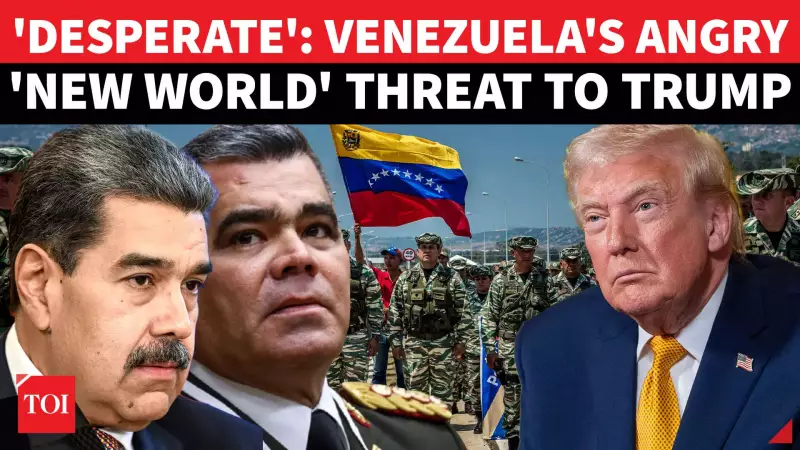
In a fiery address that underscores rising global tensions, Venezuela's top defence official has declared that the escalating confrontation with the United States could play a pivotal role in shaping the future of international relations. Defence Minister Vladimir Padrino delivered a stark warning directly to Washington, framing the Caribbean standoff as a critical juncture for world order.
A Defiant Warning From Caracas
Speaking directly to armed forces personnel in the Venezuelan capital of Caracas, Defence Minister Vladimir Padrino accused the United States of acting from a position of fear and desperation. He argued that Washington's aggressive moves are a symptom of its declining global dominance. Padrino firmly rejected what he described as foreign pressure, economic sanctions, and threatening military deployments in the Caribbean Sea.
"What happens in Venezuela will define..." Padrino stated, leaving the ominous phrase hanging to emphasise the high stakes. He insisted that his nation's goals are fundamentally peaceful, focused on sovereignty, peace, and international cooperation, not conflict.

The Spark: Tanker Seizures and a 'Naval Blockade'
The minister's sharp remarks come amid heightened alarm from the Venezuelan government over recent actions by the US. Caracas has raised a formal complaint regarding the seizure of Venezuelan oil tankers and what it terms a de facto naval blockade by American forces. This economic and military pressure has pushed Venezuela to seek international intervention.
Significantly, Venezuela, with backing from major global powers Russia and China, has brought this volatile issue before the United Nations Security Council. This move internationalises the dispute and sets the stage for a potential geopolitical showdown at the world's foremost security body. The date of Padrino's address, December 25, 2025, adds a layer of symbolism, highlighting that the crisis shows no holiday respite.
Implications for a Shifting World Order
The confrontation extends far beyond a bilateral spat. Padrino's framing positions Venezuela as a frontline state in a broader struggle against Western hegemony. The support from Moscow and Beijing at the UN indicates that the Caribbean standoff is becoming a proxy for larger tensions between established and emerging global powers.
For the United States, the actions represent a continued hardline approach towards the Maduro government. For Venezuela, it is a battle for economic survival and political legitimacy. The outcome of this crisis—whether through diplomatic channels or increased militarisation—could indeed signal how power is contested and exercised in an increasingly multipolar world, potentially defining new rules of engagement for decades to come.