

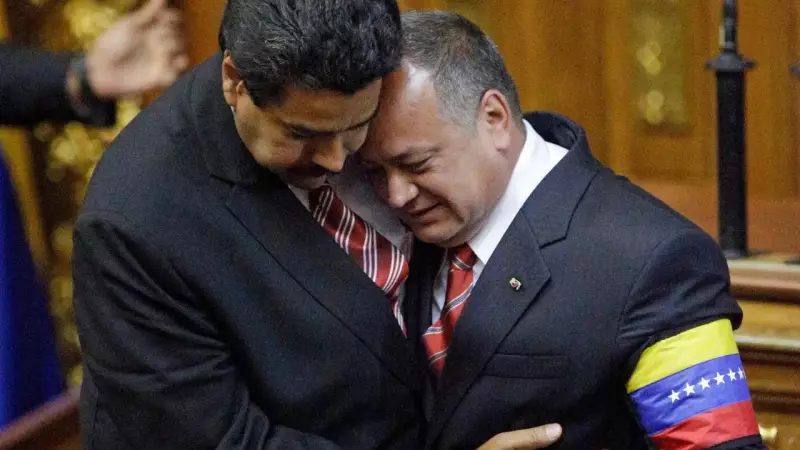
Venezuela finds itself at a critical juncture as the United States takes custody of its former leader, Nicolás Maduro. With Washington now openly shaping the country's political transition, the spotlight has shifted to the man long considered the real power behind the scenes: Interior Minister Diosdado Cabello. This development marks a dramatic escalation in the long-standing confrontation between Caracas and Washington.
The Enforcer at the Heart of Chavismo
Diosdado Cabello, aged 62, is one of the last surviving pillars of the late Hugo Chávez's inner circle. A former army officer, he participated in Chávez's failed 1992 coup attempt and later became instrumental in building the political movement that reshaped Venezuela. His political journey saw him briefly serve as president during the chaotic 2002 coup against Chávez, and he has since held some of the most powerful posts in the state.
Since his appointment as interior minister in 2024, Cabello has commanded the police, intelligence agencies, and armed civilian groups known as colectivos. Human rights organisations and a United Nations fact-finding mission have accused him of overseeing systematic repression, which includes arbitrary arrests, torture, and extrajudicial killings. Following Maduro's capture, the colectivos under his influence have been visibly deployed to patrol streets and man checkpoints across urban neighbourhoods.

Washington's Warning and Strategic Dilemma
According to reports, the Trump administration has privately cautioned Cabello that defiance could lead him to face the same fate as Maduro, who was charged with "narco-terrorism." US officials reportedly fear that Cabello, given his hardline ideology and long-standing rivalry with other figures, could sabotage a fragile transition process.
Simultaneously, Washington appears to be relying on him—at least for the moment. US Secretary of State Marco Rubio has outlined a three-stage plan focusing on stabilisation, reopening Venezuela's crucial oil sector to Western firms, and eventually transitioning to new elections. This plan currently depends on Cabello maintaining order, even as the US seeks ways to sideline him in the long term.
Cabello's Response and the Road Ahead
Cabello has responded to the crisis by projecting an image of strength and control. Social media videos show him inspecting armed units, interacting with shopkeepers, and declaring that Caracas remains "calm and tranquil." In these videos, armed men can be heard chanting slogans pledging loyalty and warning against betrayal.
Cabello has been under US sanctions since 2018 and faces a US indictment on drug trafficking charges, with a bounty on his head now standing at $25 million. He has consistently denied all allegations, labelling them as fabrications designed to justify American aggression against Venezuela and its vast oil reserves.
With Madero now out of the picture, Cabello has emerged as the most powerful Venezuelan figure still on the ground. He stands at the centre of a complex struggle involving survival, loyalty, and direct confrontation with a US administration that views him as both a necessary evil for stability and a potential next problem to solve. The coming days will reveal whether he chooses the path of cooperation or becomes the next major target in Washington's campaign.






