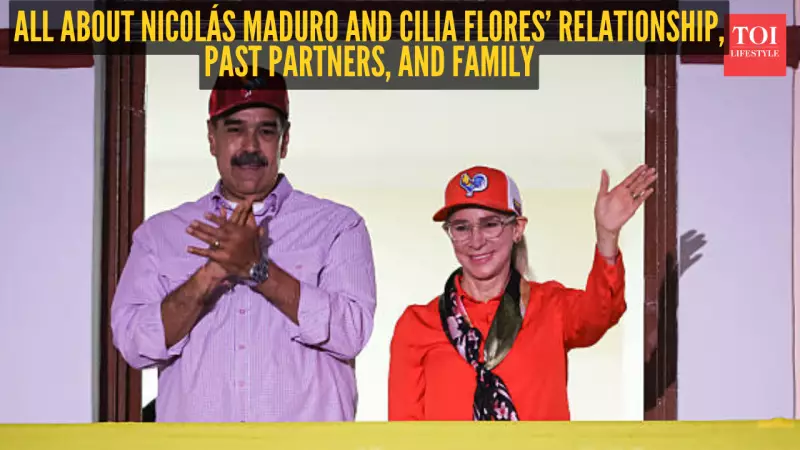
In a New York courtroom, Cilia Flores made her identity and status abundantly clear. Speaking in Spanish before entering a plea of not guilty, she declared, "I am first lady of the Republic of Venezuela." This statement was not mere formality but a reflection of the immense political power she has wielded for decades within Venezuela's ruling structure, a power now under scrutiny as she and her husband, President Nicolás Maduro, face serious charges in the United States.
The Courtroom Declaration and a Lifetime of Power
The scene in the courtroom underscored a dramatic fall. Flores, long considered a central pillar of the Chavista regime, now stands accused alongside Maduro of "narco-terrorism" and drug trafficking by US federal prosecutors. Her assertion of being the first lady was a pointed reminder of her official role, though Maduro himself has historically preferred the title "first combatant" for her. This term highlights her position on the frontlines of their political movement, far beyond a ceremonial spouse.
Analysts note that within Venezuela's complex political system, Flores's influence has often rivaled or exceeded that of other top officials, including Delcy Rodríguez, the country's former vice president and current acting leader. Her authority was not inherited but built over years through strategic positioning and an unbreakable partnership with Maduro.

A Partnership Forged in Prison and Politics
The story of Cilia Flores and Nicolás Maduro is deeply intertwined with the rise of Chavismo. They first met in the 1990s while separately visiting their political mentor, Hugo Chávez, in prison. At the time, their backgrounds were starkly different. Maduro was a bus driver and union activist. Flores, six years his senior, was already a trained lawyer working on the legal team seeking Chávez's release after his failed 1992 coup attempt.
"Flores is Maduro’s wife, first and foremost, but really more: she’s his key partner, one of his closest confidants and, in large part, helped his rise into politics," said Eva Golinger, a US lawyer and former adviser to Chávez. Golinger, who later authored a critical book on US-Venezuela relations, described their dynamic: "Flores was more the brains, and Maduro was more the brawn... she has been his pillar of support throughout everything."
After Chávez was freed in 1994, the couple immersed themselves in the political movement. When Chávez won the presidency in 1999, both were rewarded with senior posts, allowing them to steadily consolidate power within the state apparatus.
The Deliberate Rise of "Cilita"
Born in 1958 in Tinaquillo and raised in Caracas, Cilia Flores, widely known as "Cilita," built her career methodically. Her legal defense of Chávez in the 1990s was her initial political capital. She climbed the institutional ladder, serving in the National Assembly and later becoming its president—the first woman to hold that position in Venezuela.
She took on senior roles within the United Socialist Party of Venezuela (PSUV) and was eventually appointed Attorney General, a role equivalent to chief prosecutor. Her tenure was not without controversy. In 2006, as assembly president, she appointed nearly 40 relatives to public posts. When journalists investigated, she labeled them "mercenaries" and barred the press from covering congress.
Flores and Maduro formalized their personal and political union by marrying in 2013, shortly after Maduro assumed the presidency following Chávez's death.
Family Network and the Shadow of Scandal
The couple has no children together, but they have built an extensive family network. Flores has three sons from her first marriage to Walter Ramón Gavidia Rodríguez: Walter Jacob, Yosser Daniel, and Yoswal Alexander Gavidia Flores, often referred to as Maduro's stepsons. Their ages range from 28 to 39, and they have largely stayed out of the public eye, with only Walter Jacob briefly leading a government foundation.

Another family member brought notoriety. Flores raised an adopted son, her nephew, whose mother had died. This nephew was later convicted in the United States in the high-profile "narcosobrinos" (narco-nephews) drug-trafficking case, a scandal that first drew intense US scrutiny onto the family's activities.
Today, the political partnership that propelled Flores and Maduro to the apex of Venezuelan power finds them detained in a New York jail. Their journey from visiting a jailed revolutionary to becoming the faces of an alleged criminal conspiracy marks a stunning chapter for Venezuela and a personal reckoning for the woman known as the "first combatant." Her defiant courtroom statement ensures the world remembers the title she earned, even as she fights the charges that threaten her freedom.