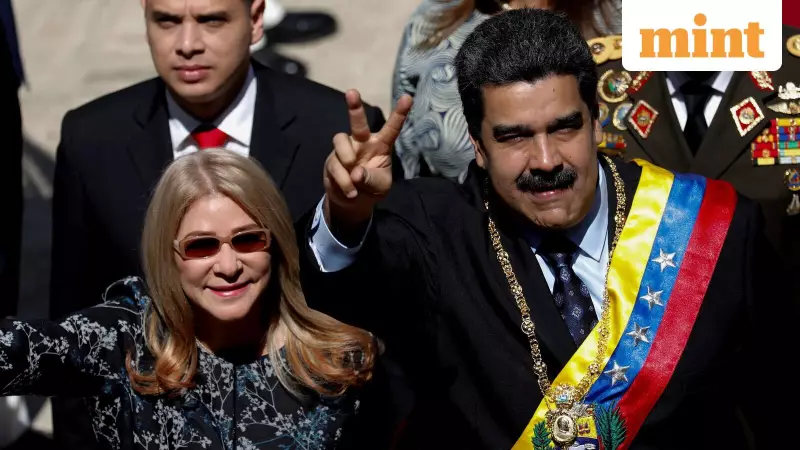
Unverified claims by former US President Donald Trump have unexpectedly refocused the world's attention on one of Venezuela's most enduring political figures. Trump stated on Monday that American forces conducted a major strike in Venezuela and extracted President Nicolas Maduro along with his wife, Cilia Flores. While Caracas has firmly rejected these assertions, the incident has once again illuminated the immense, behind-the-scenes influence of Flores, a cornerstone of Venezuela's ruling elite for over three decades.
From Tinaquillo to Caracas: The Making of a Revolutionary
Cilia Adela Flores de Maduro was born into poverty on 15 October 1956 in Tinaquillo, a small town in Cojedes state. As the youngest of six children, her early life was defined by economic struggle, prompting the family's eventual move to Caracas in search of a better future. Her academic pursuit of criminal law at a private university set her on a path that would later intersect with the nation's most turbulent political moments.
Initially, her career was apolitical. She worked part-time at a police station transcribing testimonies and later practised as a defence lawyer at a private firm. Married to a police detective and focused on raising her three sons, Flores was more concerned with professional advancement than ideological battles.

The Caracazo Awakening and Alliance with Hugo Chávez
The trajectory of her life changed irrevocably in 1989 during the Caracazo riots, a massive uprising against austerity measures that was met with a violent state crackdown. This event, which also radicalised army officer Hugo Chávez, awakened what Flores later described as her "revolutionary calling."
When Chávez was imprisoned after a failed coup attempt in 1992, Flores emerged as one of his key early civilian supporters. She provided him with crucial legal assistance and helped manage his communications with the outside world, marking her formal entry into Venezuela's revolutionary movement and forging a bond that would shape the country's future.
Architect of Power: From the Assembly to the Palace
After Chávez was pardoned in 1994, Flores advised him to shed his military image and rebrand as a civilian leader championing social justice. She became integral to the campaign machinery that propelled him to the presidency in 1998. Her own political ascent was rapid. Elected to the National Assembly in 2000, she earned a reputation as a disciplined and fierce legislator, rising to become the Assembly's president by 2007.
In 2012, Chávez appointed her as the nation's Attorney General, solidifying her control over the state's legal apparatus, a position she held until his death in March 2013.
The First Combatant: Partner to Nicolás Maduro
Flores had met Nicolás Maduro in the early 1990s while both were advising Chávez. Their partnership, both personal and political, deepened over the years. Following Chávez's death and Maduro's narrow electoral victory, the couple married in July 2013. As First Lady, Flores quickly moved beyond ceremonial duties, transforming into Maduro's most trusted adviser and a central power broker within his government, often calling herself the "First Revolutionary Combatant."
Today, Cilia Flores stands as a deeply polarising symbol of the Bolivarian revolution. To supporters, she is a dedicated guardian of Chávez's legacy. To critics, she personifies the concentration of power and the erosion of democratic norms that have contributed to Venezuela's profound economic and humanitarian crisis. Trump's recent claims, though unsubstantiated, have starkly highlighted how her journey from a poor town to the presidential palace mirrors Venezuela's own complex and contentious political evolution.