

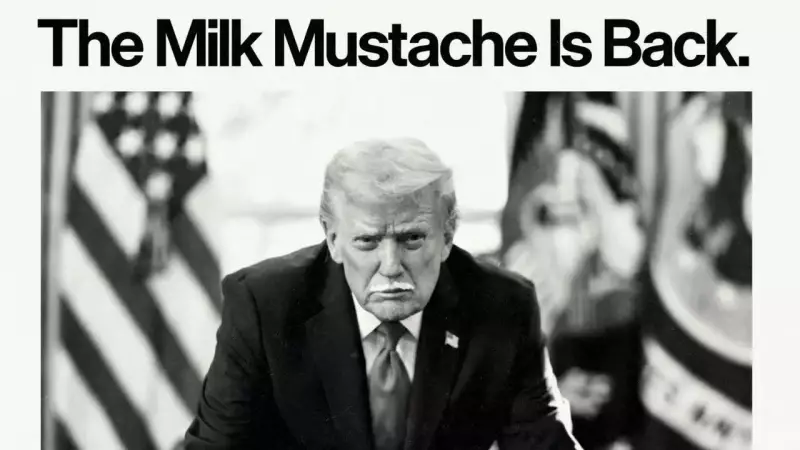
A black-and-white photograph of former US President Donald Trump sporting a distinctive milk moustache recently took the internet by storm. Deliberately modelled on the iconic 1990s "Got Milk?" advertising campaign, the image was disseminated through official channels and boosted by his allies. This was far more than a nostalgic throwback; it marked a significant pivot in American dietary policy, with whole milk being championed as a legitimate and even preferred choice for the nation's diet.
The Law Behind the Lactose: The Whole Milk for Healthy Kids Act
The timing of the post was crucial. It followed a substantial revision to federal regulations governing school nutrition. This change was enabled by The Whole Milk for Healthy Kids Act, which was signed into law in late 2025. This legislation directly overturns previous federal restrictions that, under the National School Lunch Program, limited schools to offering only low-fat or skim milk varieties.
Those older rules were initially implemented to reduce children's intake of saturated fat. However, lawmakers and school administrators argued they led to a series of negative outcomes. Participation in school milk programs fell sharply, countless cartons were thrown away untouched, and children ended up consuming fewer essential nutrients like calcium, vitamin D, and protein. Proponents of the new law contend that it prioritizes practical outcomes over theoretical guidelines, acknowledging a simple truth: children are much more likely to drink milk they actually find tasty.

Political Symbolism and Nutritional Arguments
Trump's embrace of whole milk aligns with his established political brand but is also grounded in a specific dietary debate. In this context, food transforms into a potent cultural signal. Whole milk is portrayed as "real," traditional, and minimally processed, standing in contrast to low-fat or skim milk, which supporters argue is stripped of its natural fats only to have additives or flavourings introduced later.
By evoking the "Got Milk?" era, Trump taps into a period perceived as having simpler, less contentious dietary advice. The milk moustache imagery is part of a broader messaging strategy seen in his campaigns: taking common, everyday items and reframing them as symbols of defiance against an elite-driven consensus. In this narrative, whole milk is not seen as an indulgence but as a complete food, delivering fat, protein, and fat-soluble vitamins in their natural state.
The Nutritional Debate: Pros, Cons, and Raw Milk Controversy
Advocates for whole milk highlight several practical benefits. It is more satiating than its low-fat counterparts, which can help children feel full longer and may reduce unnecessary snacking. Notably, a growing collection of observational studies has found no consistent connection between drinking whole milk and higher childhood obesity rates, challenging the core assumptions that justified the earlier low-fat mandates.
Whole milk can be especially valuable for younger children, active adolescents with high caloric needs, and student athletes, providing a dense source of calories and nutrients from a less processed option. Supporters emphasize that the argument is not that whole milk is best for every individual, but that it should be a available choice, not a forbidden one.
However, public health experts are not united. Critics caution that promoting whole milk without emphasizing overall dietary balance could lead to excessive saturated fat consumption. They maintain that nutrition policy should focus on holistic diet quality rather than isolating specific foods.
This renewed focus has also stoked the debate around raw, unpasteurized milk, with some online voices calling for greater access. Health agencies, however, continue to strongly warn against raw milk consumption due to serious risks of bacterial infections, drawing a definitive line between advocating for whole milk and endorsing raw milk.

More Than a Beverage: A Statement on Policy and Choice
The seemingly playful milk moustache image reflects a deeper transformation in how nutrition guidance is being discussed and decided. Under Trump's influence, dietary recommendations are increasingly linked to concepts of personal freedom, cultural identity, and skepticism towards evolving expert opinions.
Whether the return of whole milk to school cafeterias results in measurable improvements in children's health is a question that remains to be answered. What is already evident is that an ordinary staple like milk has become deeply politicized once again. In the current American climate, even a lunchroom carton can serve as a powerful statement about government regulation, scientific expertise, and the fundamental question of who ultimately decides what is healthy.





