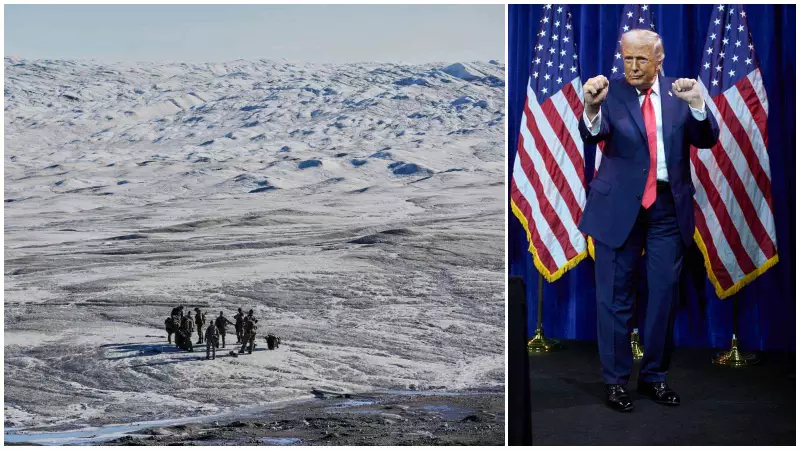
In a move that has reignited geopolitical tensions, former US President Donald Trump has reiterated his administration's interest in acquiring Greenland, framing it as a critical national security imperative. This ambition, however, faces firm rejection from Denmark and threatens the unity of the NATO alliance.
The Core Reasons Behind Trump's Greenland Push
The White House confirmed that President Trump is actively exploring options to acquire Greenland, labeling it a key foreign policy objective. Danish Prime Minister Mette Frederiksen has unequivocally stated that the autonomous Danish territory is not for sale. She warned that any US military action against Greenland would effectively end the NATO military alliance.
1. A Priceless Geostrategic Location
Greenland's immense value lies in its geography. Situated in the North Atlantic between Europe and North America, its strategic importance soared during the Cold War. The United States already operates the Pituffik Space Base (formerly Thule Air Base) there. This location provides an unparalleled vantage point to monitor and potentially intercept missiles from adversaries like Russia, China, or North Korea. Conversely, it offers a strategic launchpad for US missiles and naval assets directed towards Asia or Europe.

2. A Treasure Trove of Critical Minerals
Beyond location, Greenland is a resource powerhouse. Spanning over 836,000 square miles, the island is rich in rare earth minerals essential for manufacturing mobile phones, electric vehicles, and advanced weaponry. Currently, China dominates the global supply of these minerals, using its position to exert pressure on the US. While Greenland passed a law banning uranium mining in 2021, the broader treasure of minerals remains. Trump publicly downplays this motive, stating, "We need Greenland for national security, not for minerals." However, his former national security adviser, Mike Waltz, told Fox News in January 2024 that the focus was indeed "about critical minerals" and "natural resources."
3. The Changing Arctic Calculus
Climate change is a silent driver of this interest. As global warming melts Arctic ice, new shipping routes and access to previously locked resources are emerging. This has triggered a scramble among major powers to establish influence in the region. The US aim appears to be to pre-empt a larger Russian or Chinese role in and around Greenland, even as Trump has historically dismissed the climate crisis.
Escalating Rhetoric and Looming Threats
The situation intensified following US military operations in Venezuela. The day after, Trump reaffirmed the desire to acquire Greenland "from the standpoint of national security." His rhetoric grew sharper, claiming, "Greenland is covered with Russian and Chinese ships all over the place," and asserting that Denmark is incapable of managing the territory's security.
Adding fuel to the fire, Stephen Miller, White House deputy chief of staff for policy, echoed these claims. Subsequently, his wife, right-wing podcaster Katie Miller, posted a provocative image on social media platform X: a map of Greenland draped in the American flag, captioned "SOON."
Implications for NATO and Global Response
The prospect of US military action to seize Greenland presents an existential crisis for NATO. Prime Minister Frederiksen declared that an attack on a NATO ally would mean "everything stops, including NATO." European powers have rallied behind Denmark. In a powerful joint statement, the leaders of Britain, Germany, France, Poland, Italy, Spain, and Denmark asserted, "Greenland belongs to its people. It is for Denmark and Greenland, and them only, to decide." They emphasized that Arctic security must be a collective effort within NATO, which includes the United States.
This standoff places the world's most powerful military alliance in an unprecedented dilemma, balancing the ambitions of its leading member against the sovereignty of another and the foundational principles of the alliance itself.