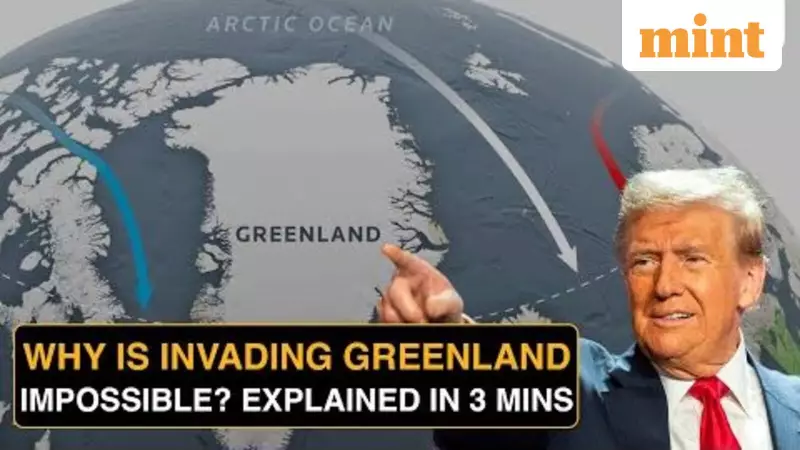
In a move that has reignited geopolitical tensions, former and potential future US President Donald Trump has publicly revived ambitions to bring Greenland under American control. Framing it as a critical national security necessity, Trump's strategy hints at considering all options, including purchase or seizure, to counter the growing influence of Russia and China in the Arctic region.
The Strategic Prize and Its Perilous Reality
The allure of Greenland is undeniably potent from a strategic resources perspective. The world's largest island is believed to hold vast reserves of oil, valuable minerals, and rare earth elements, alongside significant hydropower potential. Control over Greenland would offer the United States a formidable strategic edge for monitoring ship movements and military activities in the increasingly contested Arctic.
However, this ambition starkly contrasts with the island's harsh and volatile reality. Greenland is dominated by a two-mile-thick ice sheet that covers most of its landmass. The environment is characterized by freezing temperatures, collapsing coastal cliffs, the threat of tsunamis from landslides, and rapidly melting permafrost. These factors make any large-scale extraction or development not just challenging, but potentially deadly.

Ignored Warnings and Historical Precedents
The proposal appears to overlook significant historical, environmental, and human costs. The trauma of the Inuit indigenous population, whose homeland this is, seems to be a secondary concern. Furthermore, Greenland's own 2021 ban on oil exploration highlights its commitment to a different future, a policy directly at odds with Trump's vision.
History also offers cautionary tales. Past endeavours, from the failed Norse settlements centuries ago to the eventual closure of several US military bases established during the Cold War, underscore the difficulties of sustaining a long-term presence in such an extreme environment. These lessons from the past are being ignored in the current geopolitical calculus.
The Real Treasure: Ice and the Global Climate Threat
Experts argue that the true value of Greenland lies not in the resources beneath its ice, but in the ice itself. The massive Greenland ice sheet acts as a crucial regulator for global sea levels and climate patterns. Its accelerated melting, exacerbated by global warming, poses an existential threat far beyond the Arctic.
A complete melt of Greenland's ice cap could lead to a catastrophic global sea-level rise of up to 23 feet (7 meters). This would inundate coastal cities worldwide, displace hundreds of millions of people, and trigger a global humanitarian and economic catastrophe. Pursuing resource extraction could potentially accelerate this process, making the strategic gambit a profound environmental risk.
In conclusion, while the Trump Greenland plan is framed around great power competition and resource security, it dangerously underestimates the immense environmental fragility and the long-term global consequences. The move risks severe geopolitical backfire, alienating allies, and could potentially hasten the very climate disasters that threaten global stability. The updated discourse as of early January 2026 shows that this high-stakes Arctic gamble remains a volatile element in international relations.