

Record Gold and Silver Prices Trigger Fundamental Shift in India's Jewellery Trade
In a dramatic development that has sent shockwaves through the bullion and jewellery industry, gold and silver prices soared to unprecedented levels on Thursday, fundamentally altering long-standing business practices across India. The extreme price volatility has compelled jewellers to abandon traditional booking models, marking a significant structural shift in the trade.
Global Rally Fuels Domestic Surge to Historic Peaks
The domestic price surge mirrors a powerful global rally, with gold extending its record-breaking run and poised for its best monthly performance since 1973. This remarkable ascent is primarily driven by heightened economic uncertainty and escalating geopolitical tensions, while silver has also scaled record highs on robust safe-haven demand.
Reflecting this global momentum, domestic markets witnessed historic price levels:

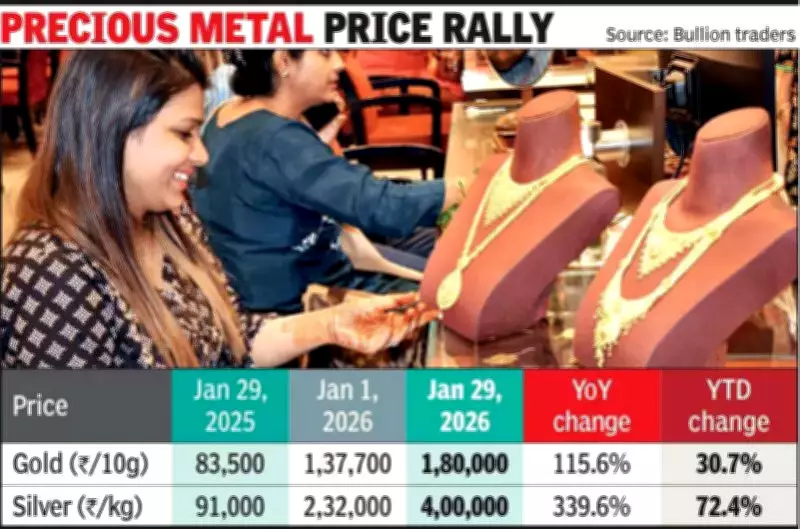
- Gold touched Rs 1.8 lakh per 10 gram, representing a substantial 30.7% increase year-to-date and an astonishing 115.6% rise year-on-year.
- Silver reached Rs 4 lakh per kilogram, posting a remarkable 72.4% year-to-date gain and a staggering 339.6% surge over the past year.
Geopolitical and Economic Factors Amplify Price Momentum
The rally intensified following reports that former US President Donald Trump was considering a fresh strike on Iran, amplifying geopolitical risk perceptions. Additionally, the US Federal Reserve's decision to maintain unchanged interest rates on January 28 provided further support, even as markets continue to anticipate up to two rate cuts later this year.
Haresh Acharya, director of the India Bullion and Jewellers' Association, emphasized that this sharp rise is largely driven by global macro factors rather than physical demand. "Safe-haven buying, geopolitical uncertainty and expectations of rate cuts are pushing prices higher. At these levels, price discovery is led by macro cues and investment flows, while jewellery demand remains weak," he explained.
Traditional Booking Models Collapse Under Price Pressure
On the ground, the unprecedented price surge has completely disrupted conventional trade practices. Jigar Patel, treasurer of the Jewellers' Association in Ahmedabad, revealed that jewellers have traditionally accepted token amounts during booking and collected full payment upon delivery. "Earlier, price movements were limited, and booking jewellery against a token amount was common. However, after gold crossed the Rs 1 lakh per 10 gram mark, volatility increased sharply," he noted.
Patel elaborated that in numerous instances, gold prices now escalate by over 10% between the booking date and delivery, resulting in significant losses for jewellers who must replenish inventory at higher rates. "As a result, jewellers largely stopped accepting bookings against token payments and are insisting on full advance, even from regular customers," he stated, highlighting the profound transformation in payment protocols.
Changing Consumer Preferences and Wedding Segment Impact
The impact of record prices is visibly reshaping consumer preferences, particularly within the crucial wedding jewellery segment. Jigar Soni, president of the Jewellers' Association of Ahmedabad, observed that wedding-related purchases are now strictly confined to fixed budgets, with buyers increasingly opting for 16- and 18-carat jewellery instead of traditional 22-carat gold.
"There is only a very small segment still buying 22-carat gold for jewellery. Demand for other lightweight jewellery also slowed sharply due to the steep rise in gold prices. Overall, jewellery demand remains muted, while investment demand in both gold and silver continues to be strong," Soni remarked, underscoring the divergent trends between ornamental and investment demand.

Inventory Management Emerges as Critical Challenge
With prices experiencing sharp daily fluctuations, managing inventory risk has become a paramount concern for jewellers. Kalpanik Choksi, a prominent city jeweller, described how the business model itself has undergone a structural transformation. "At these price levels, daily price movement is extremely high. Jewellers have to immediately buy gold to replace what they sell, and delayed payments expose them to significant risk," he explained. "The entire jewellery business effectively became a spot payment business."
Investment Demand Sustains Bullion Movement Amid Muted Jewellery Sales
Despite subdued jewellery demand, bullion movement remains robust, propelled by vigorous investment buying and hedging activity. Futures pricing on the Multi Commodity Exchange of India indicates expectations of continued firmness in both gold and silver, reinforcing cautious trade behaviour in the near term.
Market participants anticipate that prices will continue to track global macroeconomic indicators, currency movements, and geopolitical developments. Volatility is likely to remain elevated as precious metals navigate uncharted territory, maintaining pressure on trade practices and consumer behaviour across India's jewellery landscape.





