

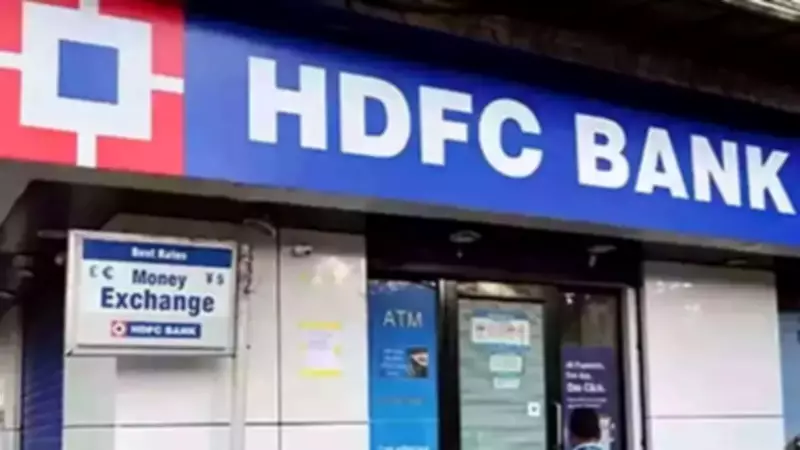
Reports that HDFC Bank used "marketing expenses" to compensate a state agency for placing large deposits rattled investors, with the bank's shares falling 2.6%, erasing over Rs 30,000 crore in market capitalisation in a single day. The controversy involves the Maharashtra State Road Development Corporation (MSRDC), whose officials said the 1.5% payout over the stated interest rate was a long-standing business model and an industry-wide convention during land acquisition exercises.
MSRDC's Defence of the Payout
Senior MSRDC officials told TOI that such payments are often structured to avoid setting precedents in deposit pricing. "When you pay a differential amount to one depositor, you don't want to set it as a precedent. So, it is classified as a marketing expense," officials said. They added that banks also pay commissions to intermediaries who mobilise deposits, typically linked to quarterly average balances. However, RBI rules disallow any incentive for deposit mobilisation.
Allegations and Investor Reaction
A report by The Indian Express alleged a quid pro quo arrangement where the bank compensated MSRDC for bulk deposits through marketing outlays in FY24 and FY25. The report rattled investors, leading to a 2.6% drop in HDFC Bank shares and a loss of over Rs 30,000 crore in market cap in a single session.

At issue is not merely nomenclature but intent. According to the report, additional payments were effectively incentives to secure deposits, which the Reserve Bank of India explicitly prohibits. While banks are permitted to offer differential interest rates on bulk deposits (term deposits of Rs 3 crore and above), such flexibility does not extend to inducements. Nor does it apply to certain statutory schemes, including those under the Bank Term Deposit Scheme, 2006, and the Capital Gains Accounts Scheme, 1988.
HDFC Bank's Response
The bank has pushed back forcefully. "We strongly reject any assumptions of wrongdoing or culpability based on selective material," it said, maintaining that robust internal oversight, audit mechanisms and process controls are consistently followed. A detailed questionnaire sent to HDFC Bank remained unanswered.
Broader Context
The controversy follows the resignation of former chairman Atanu Chakraborty, who stepped down citing concerns around values and ethics. Since his departure, the bank's shares have declined by nearly 10%. An internal RBI probe is underway to investigate the matter.






