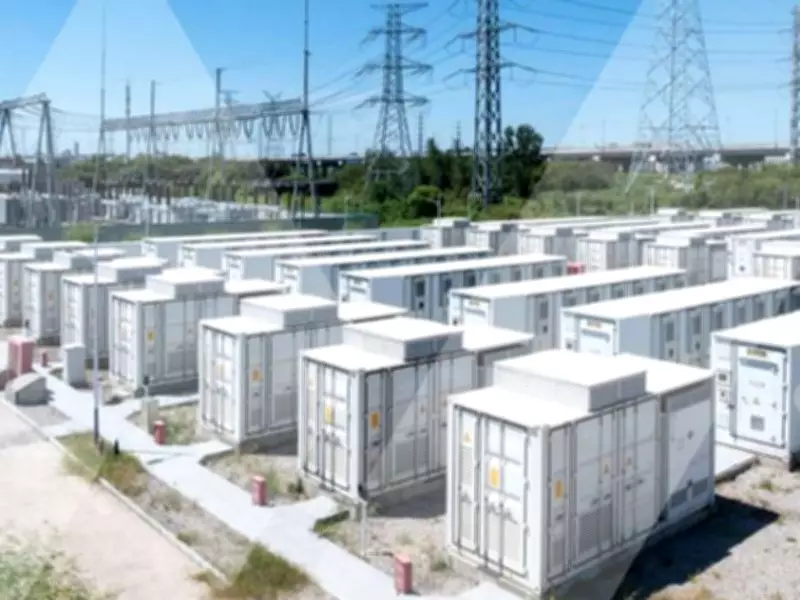
The Economic Advisory Council to the Prime Minister (EAC-PM) has released a report stating that India's power grid is no longer primarily limited by electricity generation capacity but by its ability to respond quickly to changing demand. The report identifies battery storage as the key solution for ensuring grid stability.
Rapid Solar Growth Reshapes Grid Stress
The report, titled 'The Duck and The Camel: Tracing the Net Load on the Indian Power Grid,' explains that the rapid growth of solar power has fundamentally altered the nature of stress on India's electricity system. It notes that the best way to smooth fluctuations in demand and price is to store electricity when it is abundant and release it when it is scarce.
According to the report, India's electricity demand is increasingly experiencing sharp fluctuations within a single day as solar generation rises during the day and falls rapidly after sunset. To analyze this trend, the report mapped the net-load curve—total demand met minus solar output—using high-frequency grid data at 15-minute intervals over a 24-hour period.

Duck and Camel Curves Identified
The report analyzed individual summer and winter days and compared monthly averages across years to identify structural changes in the power system. During summer, when cooling demand is high and solar generation is at its strongest, the net-load curve resembles the globally recognized 'duck curve,' with a deep midday trough followed by a steep evening rise.
In winter, the pattern changes into a 'double-humped Bactrian camel,' with electricity demand peaking in the morning and again in the evening, separated by a midday dip supported by solar generation.
Focus Shifts from Generation to Flexibility
The report states that these changing demand patterns have shifted the focus from adding generation capacity to improving grid flexibility. 'The grid is now bound by when it can generate the electricity required, and how fast it can change what it generates. In other words, the active constraint for the grid has shifted from generation capacity to flexibility. Storage is the obvious solution. However, the storage gap is large and needs to be filled quickly,' the report says.
According to the report, flattening even half of the evening rise in electricity demand during a typical summer day would require about 130 GWh of battery discharge between 1 pm and 8 pm. However, India's existing storage infrastructure remains significantly below the required level.
Storage Gap Remains Large
The report notes that India's entire pumped-storage and battery fleet discharged only about 23.8 GWh across an average day in May 2026. It adds that 'the shortfall is overwhelmingly a battery shortfall.' Against the National Electricity Plan's projection of 8.68 GW of grid-scale batteries for 2026-27, only 0.27 GW was operational till January 2026. While recent capacity additions have increased Battery Energy Storage System (BESS) capacity to 2.7 GW, the report says 'the gap still remains large.'
California Example Shows Potential
The report cites California as an example of how battery storage can reduce pressure on the electricity grid. California's battery fleet, capable of discharging more than 10 GW, stores excess solar power during the day and releases it during the evening, reducing the evening net-load swing from nearly 28 GW to about 10 GW. According to the report, this is the capability India will require as its solar power capacity continues to expand.
The report concludes that expanding battery storage alongside renewable energy capacity would be essential to reduce grid stress and improve the flexibility of India's power system.