

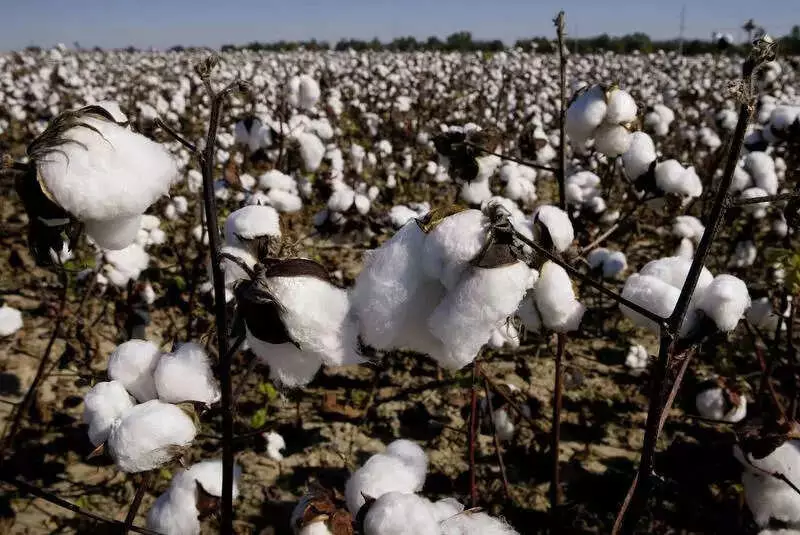
In a severe blow to Punjab's cotton farmers, data from the Punjab State Agricultural Marketing Board reveals a distressing trend for the 2024 season. Nearly 61% of the cotton arriving in the state's grain markets was purchased below the government-set Minimum Support Price (MSP), with some stocks fetching a shockingly low price of just Rs 3,000 per quintal.
Sharp Decline in Arrivals and Prices
The cotton procurement season, which commenced on October 1, witnessed a dramatic downturn this year. Total cotton arrivals in Punjab plummeted to 2.3 lakh quintals, a sharp fall from last year's 5.4 lakh quintals. Of the cotton that did arrive, a mere 35,348 quintals were procured by the Cotton Corporation of India (CCI), while private traders purchased the bulk—1.95 lakh quintals.
This shift in procurement dynamics had a direct impact on prices. With the CCI largely absent from initial purchases, private traders dominated the market. The data shows that 1.4 lakh quintals of cotton were bought below the MSP. The maximum price recorded was Rs 7,860 per quintal, but the minimum crashed to Rs 3,000. This is devastating when compared to the official MSPs: Rs 7,710 for medium staple, Rs 8,110 for long staple, and Rs 8,010 for the variety typically grown in Punjab.

A Perfect Storm: Floods, Policy, and Historical Context
Several factors converged to create this crisis. The crop area actually increased this year to 1.19 lakh hectares from 99,700 hectares last year. However, floods damaged the yield in several areas, reducing the overall output. The situation is a far cry from a decade ago when cotton, dubbed 'white gold', was promoted in southern Malwa as a water-saving alternative to paddy.
The crop's sheen began fading after the massive whitefly attack in 2015, reducing cultivation to near 1 lakh hectares. This year's procurement was further complicated by a new digital mandate. Starting from the 2025-26 season, the CCI introduced the Kapas Kisan app for Aadhaar-based registration to ensure transparency.
However, the rollout faced significant teething problems. Many farmers struggled with the self-registration process, which required uploading valid land records and sowing area details certified by revenue officials. CCI officials, speaking anonymously, confirmed that the corporation only purchased from registered farmers with verified records and acceptable moisture content. This procedural hurdle kept the CCI away from the markets in the early part of the season, leaving farmers at the mercy of private traders.
Consequences and the Road Ahead
The immediate consequence is severe financial distress for cotton growers in Punjab's Malwa region, particularly around Bathinda. The drastic fall in prices below the safety net of the MSP raises serious questions about the effectiveness of price support mechanisms in the face of market realities and new administrative procedures.
While the Kapas Kisan app aims for long-term transparency, its abrupt implementation without adequate farmer readiness training or support infrastructure has exacerbated a bad year. The combined effect of natural calamity and policy friction has pushed a once-lucrative crop deeper into crisis. The data underscores an urgent need for a review of the digital procurement process and more robust support to ensure farmers are not forced to sell their 'white gold' as distress sale.






