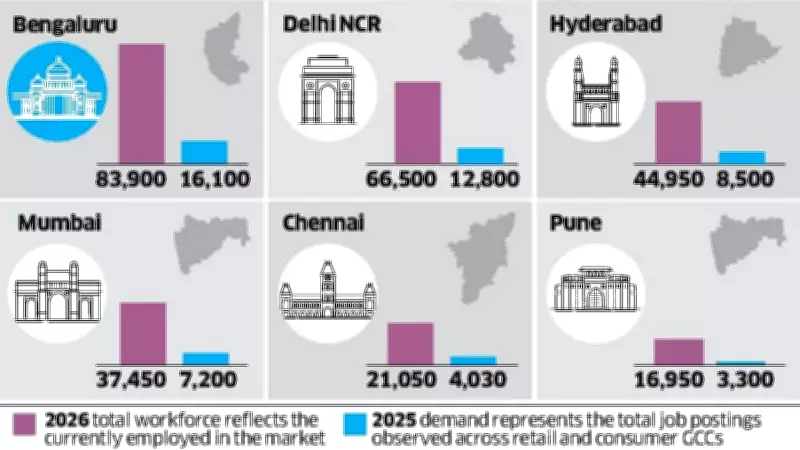
Bengaluru has emerged as the leading hub for artificial intelligence talent within retail global capability centres (GCCs), commanding a 30.6% share of the sector's AI workforce, according to a recent industry analysis. The city anchors advanced AI mandates for Walmart Global Tech, Target, Amazon, Tesco and Lowe’s, spanning generative AI, search, personalisation, supply-chain intelligence and product engineering.
Dominance in Retail AI Talent
The 30.6% figure underscores Bengaluru's strategic importance in the retail GCC landscape. The city's ecosystem of engineering talent, startup culture, and established technology infrastructure has made it a preferred location for multinational retailers to set up advanced AI centres. These centres are not merely support units but are driving core innovation in areas such as GenAI-powered customer interactions, real-time inventory optimisation, and personalised shopping experiences.
According to Uma Kannan, who reported the findings, the concentration of AI talent in Bengaluru is significantly higher than in other Indian cities. For instance, cities like Hyderabad, Pune, and Chennai collectively account for a smaller share, with none exceeding Bengaluru's dominance. This trend reflects a broader shift where GCCs are moving from cost arbitrage to value creation through AI and machine learning.

Key Players and Their AI Focus
Walmart Global Tech, one of the largest GCCs in Bengaluru, is leveraging AI for supply-chain intelligence, demand forecasting, and automated warehouse management. Target's GCC focuses on personalisation algorithms and search optimisation to enhance customer experience. Amazon's AI teams in the city work on recommendation systems, voice commerce, and logistics optimisation. Tesco and Lowe’s are also investing heavily in AI for product engineering and customer analytics.
“Bengaluru’s talent pool is unmatched when it comes to deep-tech AI skills,” said a spokesperson from a leading retail GCC, on condition of anonymity. “The city offers a unique blend of academic rigour and industry experience that is critical for complex AI projects.”
Impact on the Retail Sector
The concentration of AI talent in Bengaluru is driving significant innovations in retail. Generative AI is being used to create personalised marketing content, while supply-chain intelligence is reducing costs and improving efficiency. For example, predictive analytics powered by AI helps retailers manage inventory levels, reducing waste and ensuring product availability. Personalisation engines are increasing customer engagement and conversion rates.
The trend also has implications for the broader Indian economy. The retail GCC sector in India is expected to grow at a compound annual growth rate of 12-15% over the next five years, with AI playing a central role. Bengaluru's leadership position is likely to attract further investments, creating a virtuous cycle of talent development and innovation.
Challenges and Future Outlook
Despite its dominance, Bengaluru faces challenges such as rising real estate costs, talent attrition, and infrastructure strain. However, the city's ability to attract and retain top AI talent remains strong. Industry analysts predict that Bengaluru will continue to lead retail GCC AI talent for the foreseeable future, though other cities may emerge as niche hubs for specific AI domains.
In conclusion, Bengaluru's 30.6% share of retail GCC AI talent highlights its pivotal role in the global retail technology ecosystem. With major players like Walmart, Target, Amazon, Tesco, and Lowe’s driving advanced AI mandates, the city is set to remain at the forefront of retail innovation.