Commerce Minister Piyush Goyal Launches Scathing Attack on Congress Over Trade Deal Record
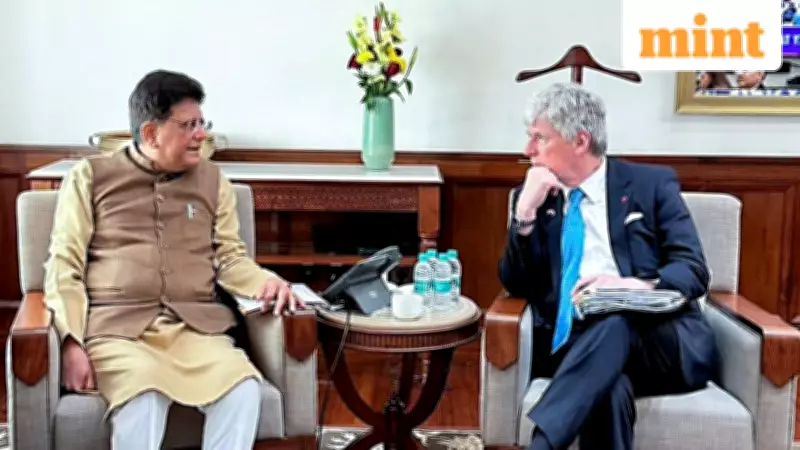
Union Minister of Commerce and Industry Piyush Goyal has launched a blistering critique of the Congress party's historical approach to free trade agreements, employing the colloquial Hindi phrase "angoor khatte hain" to characterize the opposition's response to the recently finalized India-European Union Free Trade Agreement. The minister's comments come amidst heightened political discourse surrounding India's landmark trade pact with the 27-nation bloc.
Goyal Accuses Congress of Stalling Development and Endangering National Interests
In a pointed address, Goyal specifically targeted Congress leader and former Environment Minister Jairam Ramesh, labeling him as "anti-development" and holding him responsible for impeding the nation's economic progress during his tenure. The minister emphasized that the Congress party had initiated discussions for the India-EU FTA back in 2006 and formally launched negotiations in 2007, yet failed to bring them to fruition before abandoning the process in 2013.
"It's like angoor khatte hai," Goyal remarked, drawing parallels to the fable of sour grapes. "They didn't even have the courage or the will to finalize an agreement. Out of fear, the UPA and Congress governments could never take decisive action."

Congress Questioned Over China FTA Considerations and RCEP Involvement
The Union Minister raised serious concerns about the Congress party's past considerations regarding trade agreements with China, demanding accountability for what he described as potential risks to India's economic sovereignty. Goyal questioned how the party could have contemplated allowing India to join the Regional Comprehensive Economic Partnership, which he characterized as effectively constituting a free trade agreement between India and China.
"The Congress party's track record is that bad," Goyal asserted. "Friends like Jairam Ramesh and parties like the Congress were pushing India to enter into an FTA with China. I want to ask them directly: How did you even think of letting India enter RCEP? How did you have the courage to put India at risk? This was a grave mistake by Congress."
Contrasting UPA and NDA Approaches to Free Trade Agreements
Goyal highlighted significant differences between free trade agreements signed during the United Progressive Alliance government's tenure and the recently concluded India-EU pact. He criticized previous FTAs with Japan and Korea, claiming they failed to deliver promised benefits to Indian exporters while allowing imports from those countries to double.
"The Congress government had signed an FTA with Japan and Korea," Goyal noted. "That FTA was so bad that our exports to those countries haven't increased at all. The products on which they gave us duty concessions are not even reaching those markets."
India-EU FTA Represents Major Economic Milestone
The newly finalized India-European Union Free Trade Agreement represents a substantial achievement after nearly two decades of intermittent negotiations. The comprehensive pact facilitates simplified trade in goods between India and the EU, accessing a combined market of approximately 2 billion consumers that accounts for roughly 25% of global GDP.
Jairam Ramesh had previously questioned the agreement, describing it as "hugely hyped" and expressing concerns that tariff reductions on over 96% of EU exports to India could significantly increase imports and widen India's trade deficit. The Congress leader also criticized the government's failure to secure exemptions for aluminum and steel exporters from the EU's Carbon Border Adjustment Mechanism.

Key Implications of the Political Exchange on Trade Policy
- The India-EU FTA marks a significant advancement in India's international trade relations after prolonged negotiations
- Goyal's criticism underscores ongoing political debates regarding trade policy continuity and effectiveness
- Questions about past FTA considerations with China highlight persistent concerns about economic sovereignty
- The exchange reflects broader discussions about balancing trade liberalization with domestic industrial protection
- Historical comparisons between UPA and NDA trade agreements continue to shape political narratives
The minister's forceful remarks have intensified the political dialogue surrounding India's trade strategy, with the Congress party yet to issue a comprehensive response to the allegations regarding their historical handling of free trade negotiations and considerations involving China.