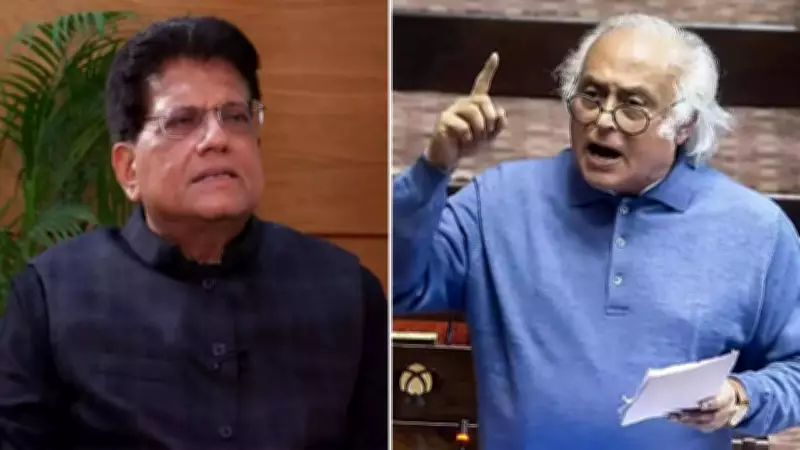
Union Commerce and Industry Minister Piyush Goyal delivered a sharp rebuke to the Congress party on Thursday, mocking their criticism of the recently negotiated India-European Union Free Trade Agreement with the colloquial phrase "angoor khatte hain" (sour grapes). In an exclusive interview with news agency ANI, Goyal launched a comprehensive defense of the landmark trade pact while attacking the opposition party's historical approach to international trade agreements.
Congress FTA Failures and China Focus
Goyal specifically targeted Congress leader Jairam Ramesh's recent criticism of the India-EU FTA, dismissing his concerns as coming from someone "considered anti-development." The minister pointed to Ramesh's tenure as environment minister, claiming he "stalled the country's development journey" during that period.
The commerce minister made startling allegations about Congress's past trade policies, accusing the party of endangering India's economic interests by pushing for agreements with China. "Friends like Jairam Ramesh and parties like the Congress were pushing India to enter into an FTA with China," Goyal stated, referring specifically to the Regional Comprehensive Economic Partnership negotiations.

Historical Trade Agreement Failures
Goyal contrasted the current India-EU agreement with what he described as failed FTAs signed during previous Congress-led governments. "The Congress government had signed an FTA with Japan and Korea. That FTA was so bad that our exports to those countries haven't increased at all," he claimed.
The minister elaborated that products receiving duty concessions under those agreements weren't reaching target markets, while imports from those countries into India had doubled. He positioned this as evidence of poor negotiation and planning by previous administrations.
Defending the India-EU Agreement
In response to Ramesh's specific concerns about the EU's Carbon Border Adjustment Mechanism potentially harming Indian aluminum and steel exports, Goyal presented the current agreement as fundamentally different and more balanced. "Here, 99% of everything exported from India will have zero duty. We have negotiated balanced FTAs," he asserted.
The commerce minister emphasized that unlike previous governments, the current administration doesn't "sign FTAs with countries that compete with us or those with lower labour costs that would harm our manufacturers." He positioned this as a strategic approach protecting domestic industry while expanding international market access.
Economic Growth and Development Claims
Goyal also countered Congress leader Rahul Gandhi's recent characterization of the Indian economy as "dead," pointing to India's status as "the world's fastest-growing large economy" with growth rates of 7-8% that outpace other major economies.
The minister highlighted several development indicators under the current government, including 25 crore people emerging from poverty, youth becoming job creators through startups, nationwide infrastructure expansion, rising incomes, and reduced taxes. "Congress's negative mindset can no longer stop it. That mindset kept India backward for decades," Goyal added.
Strategic Significance of India-EU FTA
Goyal positioned the India-EU agreement as more than just a trade deal, calling it a "landmark achievement" that "places India at the high table of international geopolitics." He credited Prime Minister Narendra Modi's leadership for gaining India recognition and importance worldwide.
"Today, India is sought after as a trading partner and strategic ally by developing nations across the globe," Goyal stated. He emphasized that the agreement with 27 EU countries creates "mutual complementarity" and acts as a "force multiplier" for both economies.
The minister concluded by framing the agreement as part of India's broader economic transformation and growing global influence, contrasting it with what he characterized as the Congress party's historically cautious and ineffective approach to international trade negotiations.