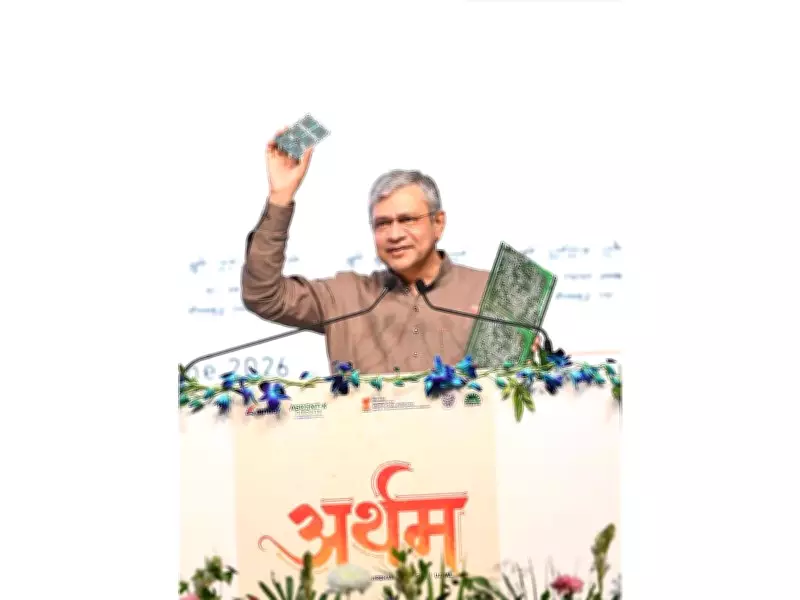
On Saturday, Uttar Pradesh Chief Minister Yogi Adityanath and Union Minister for Electronics & IT, Railways and Information & Broadcasting, Ashwini Vaishnaw jointly laid the foundation stones for two major electronics manufacturing projects at Yamuna City, Jewar, in Gautam Buddha Nagar district. The projects involve an investment of approximately Rs 6,750 crore, according to a government release.
Jewar to Become a Leading Electronics and Semiconductor Hub
Addressing the gathering, Ashwini Vaishnaw said that Jewar is poised to emerge as one of India's leading hubs for electronics and semiconductor manufacturing in the coming years. He explained that the facilities would manufacture advanced multi-layer Printed Circuit Boards (PCBs), one of the most critical components of modern electronic devices. These highly sophisticated PCBs, comprising up to 20-22 layers of integrated circuitry within an extremely thin structure, form the backbone of today's electronics industry.
Vaishnaw noted that PCBs worth nearly Rs 40,000 crore, which were earlier imported into the country, will now be manufactured domestically, with Jewar emerging as a major production centre, as per the Ministry of Electronics & IT statement.

Strengthening India's Electronics Ecosystem
The Union Minister further stated that following the development of the semiconductor ecosystem, Jewar is now poised to become a major centre for electronics manufacturing as well. He expressed confidence that several new electronics manufacturing projects would be established in Uttar Pradesh, enabling the state to emerge as one of the country's leading electronics and semiconductor manufacturing hubs. The projects would strengthen India's journey towards technological self-reliance and give fresh momentum to the vision of Aatmanirbhar Bharat by expanding domestic manufacturing capabilities across the electronics value chain, according to the ministry.
Infrastructure Boost: Bullet Train Corridor
Highlighting the transformative impact of infrastructure, Ashwini Vaishnaw said that the proposed Delhi-Lucknow-Varanasi-Patna-Siliguri Bullet Train corridor will redefine connectivity across Uttar Pradesh and act as a catalyst for industrial and economic growth. The journey from Delhi to Lucknow via bullet train will be completed in just 2 hours and 10 minutes, while the trip from Jewar to Lucknow will take only 1 hour and 40 minutes. He noted that world-class transport infrastructure, coupled with a robust electronics manufacturing ecosystem, will significantly enhance the state's attractiveness as an investment destination.
First Industrial Unit in Electronics Manufacturing Cluster
During the programme, Chief Minister Yogi Adityanath also laid the foundation stone of the first industrial unit to be established in the Electronics Manufacturing Cluster (EMC) located in Sector-10 of the Yamuna Expressway Industrial Development Authority (YEIDA). The EMC is being developed over an area of 206 acres at an estimated cost of approximately Rs 417 crore with the support of the Government of India, including a Central Government contribution of Rs 144 crore. The project is expected to strengthen Uttar Pradesh's position as a leading electronics manufacturing destination and promote investment in high-value electronics manufacturing.
Reducing Import Dependence and Boosting Exports
The commencement of advanced PCB manufacturing in India marks an important step towards reducing the country's dependence on imports of critical electronic components. PCBs worth nearly Rs 40,000 crore, which were previously imported, will now be manufactured domestically, resulting in significant savings of foreign exchange while strengthening India's self-reliance in electronics manufacturing. Increased domestic production is also expected to create greater value addition within the country by supporting ancillary industries, generating skilled employment and building a resilient electronics supply chain, as per the ministry.

As India's electronics manufacturing ecosystem continues to expand, domestic production of high-value components such as advanced PCBs will enhance the competitiveness of Indian manufacturers in global markets. The availability of world-class manufacturing infrastructure at Jewar is expected to attract further investments across the electronics value chain, enabling India to increase exports of finished electronic products while gradually reducing import dependence on critical components. This will further strengthen India's position as a trusted global manufacturing and export hub for electronics.
India Semiconductor Mission Progress
The India Semiconductor Mission (ISM), launched under the Semicon India Programme, is building a comprehensive semiconductor and electronics manufacturing ecosystem in the country. As of June 2026, the Government has approved 12 semiconductor manufacturing projects with an investment pipeline of approximately Rs 1.64 lakh crore, comprising one semiconductor fabrication unit, two compound semiconductor fabrication units and nine semiconductor packaging units, according to the ministry.
The Mission is also strengthening India's semiconductor design ecosystem through the Design Linked Incentive (DLI) Scheme. So far, 24 design projects are being supported, 105 companies have received access to advanced Electronic Design Automation (EDA) tools, and 23 chip tape-outs have been completed at various foundries, including advanced technology nodes. Announced in the Union Budget 2026-27, India Semiconductor Mission 2.0 aims to further strengthen the ecosystem by promoting semiconductor equipment and materials, indigenous intellectual property, resilient supply chains and advanced manufacturing capabilities, reinforcing India's emergence as a trusted global semiconductor hub.