Three Distinct Used Car Markets Emerge in India
A new report from Cars24 and Team BHP has shattered the notion of a single national used car market in India. The Gears of Growth 2025 report, based on data from over 33 million users, reveals that the country operates as three distinct markets, each with its own ownership clock. The key differentiator is not the model of car but the age at which it changes hands.
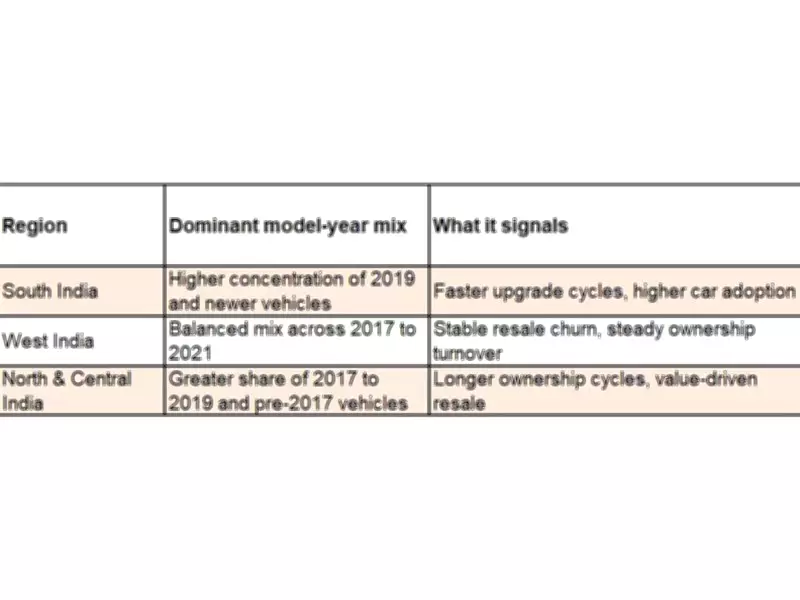
Southern markets are skewed towards vehicles from 2019 and newer. Western India shows a balanced spread of 2017 to 2021 model years. North and Central India hold onto cars the longest, with a higher share of 2017 to 2019 and pre-2017 vehicles. The report concludes that regional economics and buyer preferences shape inventory age profiles more than most buyers realise.
Regional Breakdown: South, West, and North/Central
In the South, faster upgrade cycles and higher car adoption keep inventory young. Buyers in Bengaluru, Chennai, or Hyderabad find a shelf weighted toward 2019 and newer cars. A three- to four-year-old vehicle is mainstream stock here. Tamil Nadu's share of national demand rose from 6.1 percent to 6.5 percent, and Karnataka's from 10 percent to 10.4 percent in 2025, indicating a steady climb in markets where cars circulate quickly.

Western India acts as the market's metronome. Maharashtra, the country's single largest used car market at 15.1 percent of national demand, and Gujarat, which posted the largest state-level gain of 2025 from 8.7 to 10.2 percent, both trade across an even spread of 2017 to 2021 model years. In Mumbai, Pune, or Ahmedabad, a buyer finds roughly equal odds of a five-year-old or a two-year-old car. The report calls this stable ownership churn, where cars enter and exit ownership at a consistent rhythm.
North and Central India run the longest clock. The region's higher share of 2017 to 2019 and pre-2017 vehicles points to owners who keep cars well past the national norm. A buyer in Delhi NCR or across Uttar Pradesh, which alone holds 11.7 percent of national demand, will see more six- to eight-year-old cars on the shelf than a southern buyer would. Cars in this market are held, maintained, and sold late in their life.
Why Regional Clocks Tick Differently
The report attributes the divergence to regional economics and buyer preferences. Southern states lead in adopting newer automotive technology: Karnataka and Maharashtra together account for 68 percent of all used EV purchases nationally. Markets comfortable buying the newest category of vehicle are also the markets where recent model years dominate.
Longer holding in the North is a strategy, not a lag. An owner who runs a car for eight or nine years extracts maximum use from a depreciating asset before selling it into a deep pool of value-focused buyers. The report's non-metro data reinforces this: demand there concentrates in low-maintenance, affordable models such as the Swift Dzire, Wagon R, and Alto—cars built to be owned long and sold late.
Implications for Buyers and Sellers
For buyers, geography now shapes the shelf. Someone buying a second-hand car in Chennai will encounter a younger inventory mix than someone shopping in Lucknow, where six- to eight-year-old cars are common, even on the same platform on the same day.
For sellers, the same car meets different demands depending on where it is sold. A 2020 vehicle is mid-life stock in a southern market that skews to 2019 and newer, and comparatively fresh inventory in a northern market dominated by older cars. Timing a sale against the regional clock, rather than the national average, is the more informed move.
All figures are sourced from the Cars24 Team BHP Gears of Growth 2025 report, based on Cars24 internal transaction data comprising over 33 million users as of December 2025.