

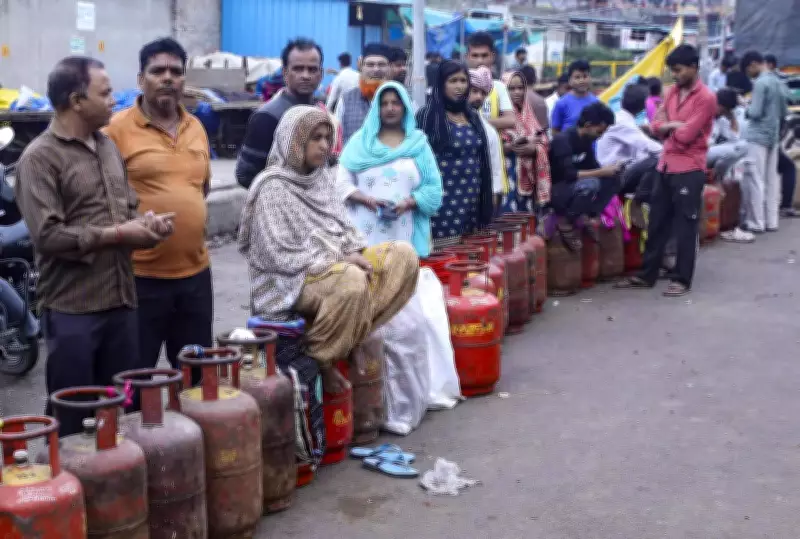
West Asia Conflict Disrupts LPG Supply in Noida, PNG Users Remain Unaffected
Noida typically maintains a steady stock of liquefied petroleum gas (LPG) lasting two to five days, serving its 10 lakh customers with efficient booking and delivery systems. Households usually keep two cylinders—when one empties, they order a replacement while using the spare. However, since Israel and the United States launched missile strikes into Iran and Tehran retaliated, this routine has been severely disrupted.
Supply Chain Disruptions Trigger Panic
Supply constraints have particularly impacted commercial food businesses and canteens, many of which have exhausted their LPG supplies and cannot secure refills. This has sparked panic booking among domestic LPG consumers, who fear a cascading effect if the West Asia conflict persists. Yet, not all kitchens are feeling the pinch. Homes connected to piped natural gas (PNG), delivered directly through pipelines, have largely continued their routines undisturbed.
The critical difference lies in supply chains. India meets 60% of its domestic LPG demand through imports, with approximately 90% of these imports originating from the Gulf region—specifically the UAE, Qatar, Saudi Arabia, and Kuwait. These exports must traverse the Strait of Hormuz, one of the world's busiest energy shipping routes, which Tehran has effectively shut down, leveraging global dependence on this waterway.

Global Shipping Delays Impact Imports
Tanker movements have slowed significantly, with vessels experiencing delays, rerouting, or operating under heightened security conditions. Consequently, LPG cargoes are taking longer to reach major Asian importing nations like India. While the United States has emerged as an additional gas source for India, West Asia remains central to India's LPG supply basket. Energy expert Narendra Taneja notes, "Some imports also come from Norway and Nigeria."
Why LPG and PNG React Differently
Both LPG and PNG originate from similar geological sources—hydrocarbons trapped deep underground. However, their journeys diverge sharply post-extraction. Taneja explains, "When you drill, sometimes you find oil with gas, sometimes only gas. Nature has stored them together in different proportions."
For Delhi-NCR, this distinction is crucial because the region boasts one of India's most developed PNG networks. As a result, LPG users here are more vulnerable to import-related turbulence. Since the West Asia conflict erupted, the central government has been actively promoting the expansion of city gas coverage, encouraging residents in areas with PNG networks to switch to piped gas if they haven't already.
Scale of LPG Distribution in NCR
Ghaziabad has 12 lakh LPG consumers. Noida delivers 18,000 to 20,000 cylinders to homes daily, while Ghaziabad handles 20,000-22,000 cylinders each day. The sheer scale underscores the potential impact of supply disruptions.
From Ship to Kitchen: The LPG Journey
Propane and butane, the primary components of LPG, are separated from natural gas, liquefied, and loaded onto specialized tankers. Hemant Mallya, a fellow at the Council on Energy, Environment and Water (CEEW), elaborates, "Both propane and butane are gases, but under pressure, they turn into liquid. That is how we store LPG in cylinders delivered to our homes. Typically, what we call LPG is about 60% butane and 40% propane."
Mallya outlines three sources of LPG:
- Crude oil refineries: Companies like IndianOil produce LPG as a byproduct of processing crude oil into petrol, diesel, and other products.
- Domestic natural gas production: Some LPG is extracted from natural gas produced within India, such as at GAIL's plant in Pata, Uttar Pradesh.
- Imports: This constitutes a major third source.
According to Petroleum Planning & Analysis Cell (PPAC) data, India produced 12.78 million metric tons (MMT) of LPG from refineries in 2024-25, while imports added 20.66 MMT. Total consumption reached 31.32 MMT.

Distribution Infrastructure and Bottling Plants
Once imported LPG reaches Indian shores, it is pumped from ships into storage tanks and transported via pipelines, trains, or road tankers to bottling plants—the backbone of the distribution system. Taneja notes, "Typically, LPG produced at refineries is bottled at facilities located at or near the refinery itself. In some cases, it may be transported to other bottling plants." India operates 23 refineries with a combined capacity of 256.8 MMTPA.
Most imported LPG arrives through Gujarat ports like Mundra, Vadinar, Kandla, and Pipavav. Other key ports include JNPT in Mumbai, New Mangalore on the west coast, and Visakhapatnam, Ennore, Paradip, and Haldia on the east coast.
A major supply line for LPG to north India is the Jamnagar-Loni pipeline, making Ghaziabad a hub for LPG bottling and distribution. This pipeline features five other 'take-off points' at Ajmer and Jaipur in Rajasthan, Piyala and Gurgaon in Haryana, and Madanpur Khadar in Delhi.
India's Vast LPG Ecosystem
India's LPG usage is staggering: over 34 crore households are LPG consumers, serviced by more than 25,000 distributors and 214 bottling plants. Throughout this process, LPG undergoes multiple transformations—starting as a gas mix underground, being separated and liquefied for transport, stored in tanks and cylinders, and finally vaporizing back into gas for household use.
PNG: A More Stable Alternative
While PNG is not entirely immune to global shocks, its pipeline system and continuous flow make it more resilient than the LPG supply chain, which depends on ships, storage, bottling, and road transport. PNG primarily consists of methane, sourced from a mix of domestic production and imported liquefied natural gas (LNG), which is regasified at terminals before entering the national gas grid.
Natural gas in India is produced offshore (e.g., Arabian Sea fields like Bombay High) and onshore (e.g., Krishna-Godavari basin). After extraction, gas is transported to processing units where impurities like water and carbon dioxide are removed. The remaining methane is compressed and sent through high-pressure, large-diameter pipelines to city gas distribution companies.
These pipelines form India's national gas grid, spanning approximately 24,000 km, with 15,978 km currently operational. GAIL alone manages around 11,005 km of this network, according to PPAC data. The grid links production sites, LNG terminals, and distribution networks, with India operating eight LNG terminals.
In the case of LNG imports, natural gas is first processed and liquefied at -160 degrees Celsius in the source country, transported in specialized tankers, stored in cryogenic tanks at LNG terminals, and then converted back to gaseous form by heating as per demand.
In 2024-25, India produced 35,595 million metric standard cubic metres (MMSCM) of LNG domestically—25,709 MMSCM offshore and 9,885 MMSCM onshore—while imports added 35,720 MMSCM. Total consumption for the year was 71,314 MMSCM, indicating that roughly half of India's PNG supply is imported.
Can Domestic LPG Production Be Increased?
During supply stress, refineries can adjust processes to produce more LPG by breaking down heavier hydrocarbons into lighter ones like propane and butane, though this entails energy and economic costs. Mallya explains, "The reason we don't produce enough LPG domestically is the nature of crude oil we process. It doesn't yield large amounts of propane and butane. Refineries can, however, tweak processes to extract more LPG by breaking down heavier hydrocarbons. Think of it like breaking a large Lego structure into smaller blocks."
Government Assurance and Current Status
Despite geopolitical uncertainties, the Ministry of Petroleum and Natural Gas has stated that the LPG supply situation in India remains stable, with no reported stock-outs or "dry-outs" at distributorships. Initial fears triggered a spike in panic bookings, with daily bookings jumping from an average of 55.7 lakh cylinders to 88.8 lakh. However, demand has since eased to around 57 lakh cylinders, and online bookings have increased from 84% to 94%, reflecting a return to a more orderly system.





