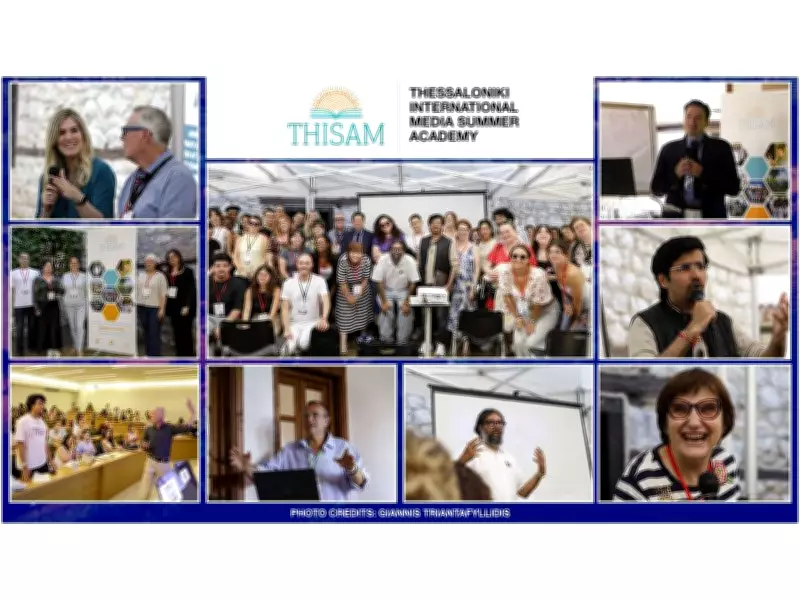
The Thessaloniki International Media Summer Academy (THISAM) relocated its opening leg to Kastoria for its 10th edition, marking the first time in nine years it left its home at Aristotle University. Organizers framed the move as an effort to expand the university's regional footprint across Macedonia, while the theme "Unveiling Tomorrow's Media: Challenges and Tools in Communication" set a tone of introspection.
Global Participation and Format
Convened by Professor Nikos Panagiotou and a consortium of 15 partner universities including Temple University, DW Akademie, Concordia University, and Hong Kong Baptist University, the academy drew 71 participants from 19 countries. Attendees included early-career journalists, scholars, NGO leaders, and media executives, with the student body spanning from Hong Kong to Montreal. The program followed a two-day "Global Media and Culture" conference on July 1-2 and featured keynotes, workshops, and cross-border collaborations.
Day one opened with remarks from Christos Frangonikolopoulos, Dean of the Faculty of Social and Economic Sciences at Aristotle University, followed by a keynote on the future of media, a workshop on solutions journalism led by Elira Canga of Arizona State's Cronkite School, and a two-hour session on winning attention in the digital era.

AI and Journalist Safety
Artificial intelligence has been on THISAM's agenda since 2018, but this year the focus shifted from novelty to consequence: generative AI's impact on automated reporting, fact-checking, newsroom judgment, and the need for human oversight. Organizers also flagged journalist safety as a growing concern, reflecting the hazardous conditions reporters face worldwide. A media literacy pilot run in 35 Greek schools with the Ministry of Education and General Secretariat of Information, recognized by UNESCO as good practice, aimed to build critical thinking against misinformation among adolescents.
The Attention Question
The most talked-about session was a two-hour workshop titled "Winning Attention in the Digital Media Era," co-led by Avinash Mudaliar, Co-Founder & CEO of HT Labs and CEO of OTTplay, and Jatin Malhotra, whose background includes product strategy roles at Oracle, Meta, and Reliance Jio. Mudaliar argued that content is no longer the scarce resource; attention is, increasingly dictated by algorithms, infinite scroll, and collapsing brand loyalty rather than editorial merit. The session became a lively exchange, with participants from the US, Europe, and Asia testing whether a model built for streaming and audio apps holds for news. Questions raised included why technically superior products lose to those that understand human behavior, whether audience attention can be built without clickbait, and what journalism should borrow from gaming and streaming design.
Beyond the Attention Discourse
Day one also featured a keynote on the future of media by Shin D. Kim, a film professor at Hong Kong Baptist University. On day two, Ludovic Blecher, Chairman of WhiteBeard and CEO of IDation, presented a concrete case of AI implementation. Sherri Hope Culver of Temple University led sessions on pop culture, propaganda, and media literacy, framing audience capture as a historical phenomenon. Visual anthropologist Dr. Dimitrios Bouras taught sessions on representing war and conflict, and collective memory in reporting—work that does not reduce to a scroll-and-engagement model.
Later sessions addressed attention in concrete terms: Niko Efstathiou, Editor in Chief of WIRED Greece, taught on wildfire misinformation, turning media literacy into a local problem. Dejan Oblak of the University of Zagreb offered "Reimagining News for the Visual Generation," an experimental case study in visual storytelling for younger audiences. Aphrodite Salas of Concordia University taught oral history as documentary practice. Faculty including Silcock, Perisin, Culver, and Panagiotou co-led a session titled "Trust and Democracy from the Agora to AI: America 250 and Fulbright Voices," placing AI within a framework of democratic trust. Panagiotou closed with "The Future Is Yours: Global Media, Leadership, and the Careers Students Must Build Now," followed by a graduation ceremony.

What AI Can't Do
Panagiotou has suggested that public discourse fixates on technological change at the expense of journalists in the field, arguing that real journalism is about understanding, interpreting, and giving meaning—work that remains irreplaceable even in the age of AI. This perspective, placed alongside the attention-focused session, reflects the ongoing conversation within THISAM 2026 about what journalism is for. The academy ran through July 10.