

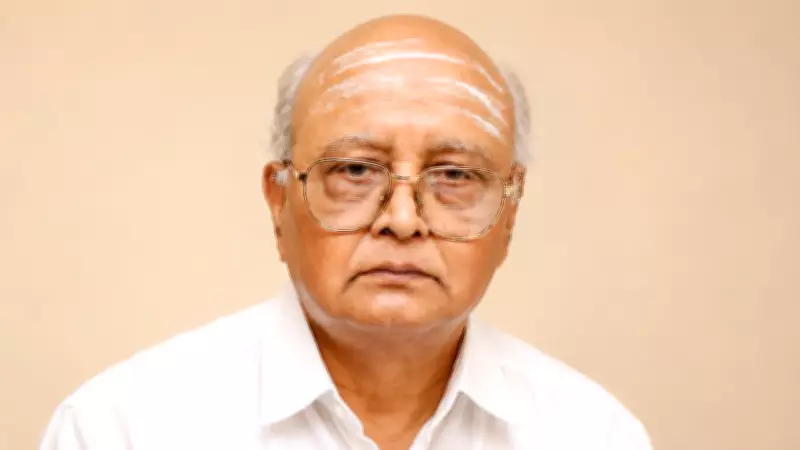
His question was always: “Why, Why and Why?” Long before Simon Sinek popularised the phrase Start with Why, Pudhucode Ramayyar Krishnamoorthy had made it the operating principle of his professional life. In the 1960s, when Indian business was still shaped by licences, permissions, labour unions, courtrooms and family-owned conglomerates, PRK, as he came to be known, built his reputation by asking the question most people preferred to avoid. Why was a file being moved? Why was a legal position being taken? Why had a precedent been ignored? Why was a transaction structured in a certain way? The question was not rhetorical. It was forensic.
In Appreciation
Krishnamoorthy, who died in Coimbatore on Sunday morning at the age of 92, was among the longest-serving executives of the Sahu Jain group, as The Times of India Group was then known. He retired around 1998 as Executive Director of Bennett, Coleman and Company Limited, publisher of The Times of India. To generations within the company, he was simply ED&S — Executive Director and Company Secretary. The “S” was not a minor addition. For much of his career, it was the centre of his authority.
Early Life and Ascent
Born in Kerala into a large family of modest means, PRK’s ascent had none of the smooth inevitability of privilege. He completed his education and stenography training in Kerala before moving to Delhi and Kolkata in search of work. What followed was a career of more than four and a half decades, built on rigour, self-education, and an almost monastic devotion to the institution he served. He became a close confidant of Sahu Shanti Prasad Jain and later Sahu Ashok Kumar Jain, at a time when the group’s interests extended across newspapers, cement, jute, sugar and other businesses. This was corporate India before liberalisation: highly regulated, frequently litigated, intensely relationship-driven and often politically delicate. Companies then needed executives who could read a balance sheet, a statute, a government's mood and a human being with equal care. PRK could do all four and more.

Legal Acumen and Professional Rigour
His command of law was formidable. Corporate law, taxation, labour law, criminal procedure — he seemed to have absorbed them not as separate disciplines but as instruments in the larger craft of protecting an institution. He worked with leading lawyers, argued through strategy late into the night, prepared for difficult cases, conducted board meetings and navigated complex transactions. He was a voracious reader and a relentless preparer. Even in his eighties, those who met him found his mind undimmed, sharp with recall and alive to nuance. Inside BCCL, his name evoked fear, respect and reverence in nearly equal measure. He was a no-nonsense administrator, meticulous to the point of discomfort, and allergic to compromise where principle or process was involved. In the age of landline extensions, a call from PRK was enough to make executives sit up straighter. Many stood up instinctively before answering. Yet the fear was never of arbitrariness. It came from the knowledge that he would know the facts, the law, the history of the matter, and the weakness in one’s argument.
Mentoring and Legacy
He mentored several leaders in BCCL, including yours truly. His method of mentoring was rarely gentle. He trained people by testing them, by pushing them to prepare better, think harder and never treat approximation as knowledge. Those who survived his rigour carried its benefits for life: discipline, stamina, accuracy and respect for detail. Outside work, PRK’s sternness gave way to a deep sense of duty. At a young age, he took responsibility for his siblings, ensuring their education and marriage, delaying his own personal life in the process. He is survived by his caring wife and daughter, who is settled in the United States.

Philanthropy and Spirituality
He was also deeply religious and philanthropic. He helped countless young people from smaller towns find employment and footing in Delhi, Bombay and Kolkata. He supported temples, educational institutions, social causes and cultural bodies, and was associated with several religious and charitable initiatives, including temple restoration. In 2017, after retirement, he published his autobiography, My Tryst with Corporates, through Bharatiya Vidya Bhavan. The book recorded his journey from Kerala to the upper ranks of The Times of India Group but its real value lies elsewhere: as a memoir of Indian corporate life before emails, consultants, dashboards and liberalisation changed the grammar of business.
A Fading World
PRK belonged to a generation of professional managers who did not seek public fame but gave private strength to great institutions. They were the custodians of memory, law, trust and continuity. His passing marks the fading of that world and of a man who asked “why” not to obstruct, but to ensure that what survived him was sound.
- The writer is CEO (Publishing), BCCL
Get the latest India news and live updates. Download the TOI App.
About the Author
Sivakumar Sundaram is CEO (Publishing), BCCL.





