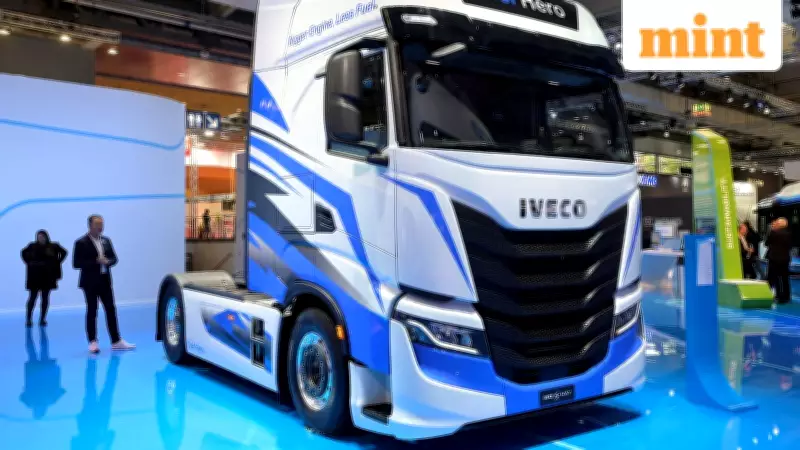
Tata Motors' $4.4 Billion Iveco Acquisition Faces Renewed Investor Concerns
Italian automaker Iveco's two consecutive reductions in its cash flow outlook within a six-month period have reignited significant concerns among analysts and investors regarding Tata Motors Ltd's monumental $4.4 billion acquisition. The volatility in Iveco's financial performance is now casting a shadow over what represents Tata Motors' largest-ever strategic purchase, with experts cautioning that the Italian business's unpredictable show could potentially leave the Indian automotive giant vulnerable to broader global economic headwinds.
Iveco's Drastic Guidance Cuts Raise Red Flags
The Turin-based commercial vehicle manufacturer executed a substantial 82% reduction in its full-year 2025 guidance for its commercial vehicle and defence business during January, slashing projections to a mere €60 million from the previously anticipated €350-400 million range. This dramatic revision follows an earlier 13% cut implemented in July 2025, when guidance was reduced from €400-450 million. Company officials have attributed these downward adjustments to persistent production delays, escalating costs within the bus manufacturing segment, and underwhelming performance across preceding quarters.
Interestingly, both these significant reductions to cash-generation forecasts have occurred subsequent to Tata Motors' formal announcement on 30 July regarding its ambitious $4.4 billion deal to acquire the truck, bus, and powertrain business divisions of Iveco. The Mumbai-headquartered automotive conglomerate is scheduled to assume operational control during the June quarter of the 2026-27 fiscal year.

Analysts Express Mounting Apprehensions
Financial analysts at Motilal Oswal Financial Services highlighted on 30 January a concerning lack of visibility in Iveco's financial projections, primarily stemming from market uncertainties across its operational territories in Europe and Latin America. In a detailed research note, analysts articulated, "Tata Motors' recent acquisition of Iveco would expose it to ongoing global macroeconomic uncertainties, thereby driving a potential de-rating if the demand environment does not show signs of improvement in the near future." The note further emphasized, "Given the lack of visibility in its financials and considering that this acquisition will initially be funded with a substantial debt of €3.8 billion, we refrain from assigning any incremental value to Iveco at this preliminary stage."
Pramod Amthe of InCred Equities had previously flagged the Italian company's erratic performance in a 4 January note, pointing out how Iveco's earnings before interest and tax (EBIT) plummeted from €375 million in the December quarter of 2024-25 to just €101 million in the September quarter of 2025-26. This volatile quarterly EBIT trend has emerged as a significant area of concern for market observers.
Investor Sentiment and Strategic Rationale
Despite these emerging concerns, current investor sentiment appears cautiously optimistic regarding the Iveco opportunity and Tata Motors' overarching performance trajectory. A majority of analysts continue to perceive the business as possessing the potential to deliver substantial long-term value. Since its separate listing on exchanges in November, Iveco's shares have witnessed a remarkable surge of 41%, starkly contrasting with the modest 1% gain recorded by the Nifty Auto index, suggesting that investors are currently pricing in a bullish scenario for the company.
The acquisition involves Tata Motors agreeing to purchase the commercial vehicle business of Iveco, which is backed by the influential Agnelli family, renowned for their association with the Fiat Group. The combined entity of Tata Motors and Iveco is projected to achieve sales exceeding 540,000 units and generate revenue surpassing $25 billion. Geographically, Europe is anticipated to contribute approximately half of the combined group's total sales, followed by India at 35%, with the remaining 15% originating from the Americas.

The Twin Challenge and Long-Term Synergies
Concerns regarding Iveco potentially weighing on Tata Motors' performance mirror challenges faced by its passenger vehicle division, which has experienced performance setbacks due to US tariffs and cybersecurity issues at its UK-based luxury subsidiary, Jaguar Land Rover (JLR). Tata Motors Passenger Vehicle Ltd has reported declining year-on-year profitability for two consecutive quarters, highlighting a parallel strain.
Nevertheless, several analysts maintain that the acquisition could yield medium- to long-term strategic gains. Analysts at Emkay Global noted in a 30 January communication, "The Iveco deal, coupled with a potential EU Free Trade Agreement, could unlock significant cross-selling opportunities and sourcing synergies involving both products and components." They added, "We have incorporated projections of €17.5 billion in revenue by calendar year 2028, with free cash flow approximating €0.8 billion, aligning with management's stated guidance."
Pramod Kumar, Vedant Kshatriya, and Hemal Bhundia of UBS Securities elaborated in a 27 January note that the acquisition is poised to substantially widen Tata Motors' geographical footprint. They expressed confidence, stating, "We expect the transaction to be value-accretive for Tata Motors. Given its relatively smaller scale compared to global peers, we anticipate that improving trucking volumes in Europe will support margin expansion and bolster cash flows, especially as the overall demand environment in the region continues to demonstrate strength."
Tata Motors' Strategic Integration Plans
In September, Tata Motors conducted an extensive meeting with analysts from India's premier brokerage houses to delineate its comprehensive strategy for Iveco and outline plans to unlock value from this high-stakes acquisition. Key initiatives include a focused effort to reduce Iveco's operating expenses by leveraging Tata's advanced engineering capabilities and common platform architectures to curtail product development costs. Furthermore, Tata's meticulous review of Iveco's supply chain has identified clear opportunities to augment sourcing from cost-effective regions like Eastern Europe and Asia, which could substantially contribute to overall cost reduction and operational efficiency.
The deal was formally announced prior to the demerger of Tata Motors' passenger vehicle and commercial vehicle businesses, with the latter entity listing independently in November. While the passenger vehicle business derives a majority of its revenue from JLR, the commercial vehicle entity is expected to secure a significant revenue share from its newly acquired Italian operations, marking a pivotal shift in its revenue composition and global market presence.