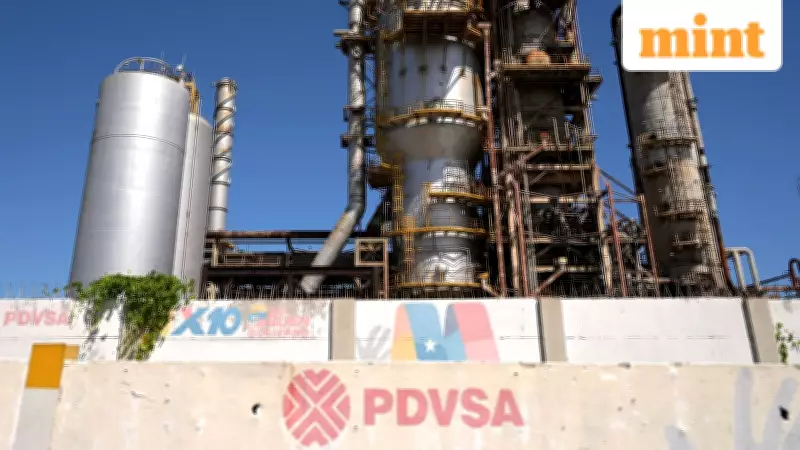
The $100 Billion Venezuelan Oil Gamble: Foreign Investors Face Legal Maze with PDVSA
Foreign energy companies are confronting a complex legal landscape as they consider investing in Venezuela's oil industry, which is projected to attract up to $100 billion. This ambitious plan hinges on partnering with Petróleos de Venezuela SA (PDVSA), the state-owned oil giant that has long been embroiled in allegations of corruption, mismanagement, and international sanctions.
A Shift in U.S. Policy and Venezuelan Law
During President Trump's first term, his administration accused PDVSA executives of embezzling billions of dollars and using company aircraft for cocaine trafficking. Now, in a significant policy reversal, the U.S. is encouraging American companies to engage in business with the Venezuelan firm. This move aims to fuel what President Trump hopes will be a massive investment surge in Venezuela's energy sector.
The Trump administration's strategy relies on foreign entities collaborating with PDVSA to tap into Venezuela's vast oil wealth, estimated to be the world's largest proven crude reserves. However, this sets up a precarious situation for investors, who must navigate PDVSA's troubled history. "If a company is going to want to do business in Venezuela, it's going to have to speak with PDVSA," said Oswaldo Felizzola, head of the energy center at the IESA business school in Caracas.

Production Decline and Recent Reforms
Venezuela's oil production has plummeted dramatically over the years. Once producing 3 million barrels per day, it dropped to a low of 300,000 barrels under President Nicolás Maduro and currently stands at about 900,000 barrels daily. Following Maduro's capture by U.S. forces on January 3, the Venezuelan regime enacted a major reform of its oil-industry law, marking a sharp departure from the Chavismo movement initiated by former leader Hugo Chávez.
Chávez had championed "oil sovereignty" with strict state control through PDVSA. The new law, however, signals a shift. Soon after its passage, the U.S. Treasury Department eased sanctions on PDVSA, issuing a general license that permits American companies to export and sell Venezuelan crude. Delcy Rodríguez, Maduro's vice president and interim leader, expressed optimism: "We hope this reform will attract significant flows of international investment. We must go from being the country with the largest oil reserves on the planet to becoming a giant producer."
Skepticism and Legal Concerns Among Investors
Despite these changes, many international oil companies remain wary. Exxon Mobil CEO Darren Wood labeled Venezuela "uninvestable," while Chevron CEO Mike Wirth, whose company is the only major U.S. oil firm operating there, indicated that expansion might be possible "with the right changes" from the government. Oxford Analytica, a geopolitical risk analysis service, noted in a recent report that "major long-term investments are likely to prove elusive, with output increases set to be gradual at best."
José Ignacio Hernández, a Venezuelan oil consultant and law professor at American University, highlighted the legal risks: "Would you sign a contract with an entity that is labeled as a criminal branch of the government of Venezuela? I would say no." Foreign companies may be hesitant to associate with PDVSA due to its history of sanctions and accusations against its managers.
PDVSA's New Role and Operational Changes
Under the reformed legislation, PDVSA is transitioning from stringent state control to a more managerial role in contracts with investors. Francisco Monaldi, director of the Latin America energy program at Rice University's Baker Institute, explained: "It will only operate a fraction of oil production, most likely less than a third." PDVSA still owns oil fields, refineries, and gas stations, but companies can now enter joint ventures where the state firm maintains majority control, with private management allowed on a case-by-case basis.

An alternative for companies is to sign service agreements with PDVSA, allowing them to operate state oil fields while bearing expenses and risks. The U.S. Treasury Department has not yet authorized American companies to pump oil, but officials are expected to continue loosening restrictions. A general license for oil extraction could be issued as soon as this week, according to sources familiar with the plan.
Historical Context and PDVSA's Downfall
Founded 50 years ago during Venezuela's oil nationalization, PDVSA was once regarded as one of the world's most efficient state oil companies. It held stakes in refineries across Europe and the U.S., where it owned gas stations through its subsidiary, Citgo. Initially, politicians avoided interference, and the company was run by highly trained professionals.
This changed under Hugo Chávez, who transformed PDVSA into an extension of his left-wing movement after taking office in 1999. He appointed political loyalists to key positions, changed the company logo to socialist red, and diverted revenue to social programs like housing and food for the poor. PDVSA also shipped subsidized oil to Cuba and other Caribbean nations to exert international influence.
In late 2002, when PDVSA workers went on strike to oppose Chávez, he fired about 19,000 employees—roughly half the workforce. This loss of experienced personnel triggered a prolonged decline in production. Juan Matias Szabo, a former senior PDVSA official, stated: "They politicized the entire PDVSA structure and diverted the cash flow to political and international issues."
Current Challenges and Economic Impact
Today, PDVSA is virtually bankrupt, with approximately $60 billion in external debt and limited capacity to boost production independently. Venezuelan economists note that the company lacks capital for investments and maintenance, leading to abandoned, rusting wells. Mismanagement, rampant corruption, and U.S. sanctions have caused oil output to tumble.
Henrique Capriles, an opposition politician in the National Assembly, emphasized the lack of transparency: "PDVSA undoubtedly has to stop being what it has been in recent years, which is the big slush fund of the ruling party." The company cannot be independently audited after years of neglect.
Nieves Ribullen, a former PDVSA worker, recalled infrastructure deterioration at the Amuay refinery in 2008, which led to an explosion in 2012 that killed over 40 people. Experts attributed the disaster to inadequate maintenance. Workers were often forced to participate in pro-government rallies, with non-compliance risking contract non-renewal.
A patronage system bloated PDVSA's payroll to around 85,000 employees, with less than 20% involved in oil activities, according to union leader Ivan Freites. Many skilled workers fled to countries like Colombia and Canada, while those remaining faced hyperinflation under Maduro. Some resorted to selling uniforms or looting equipment. Carlos Márquez, a former PDVSA employee now working in the Canary Islands, shared: "Our purchasing power fell so much that I had to drive a taxi in Venezuela just to put bread on the table."
As Venezuela pushes for a $100 billion oil investment boom, the success of this gamble heavily depends on whether PDVSA can overcome its legacy of corruption and inefficiency, offering a stable partnership for wary foreign investors.