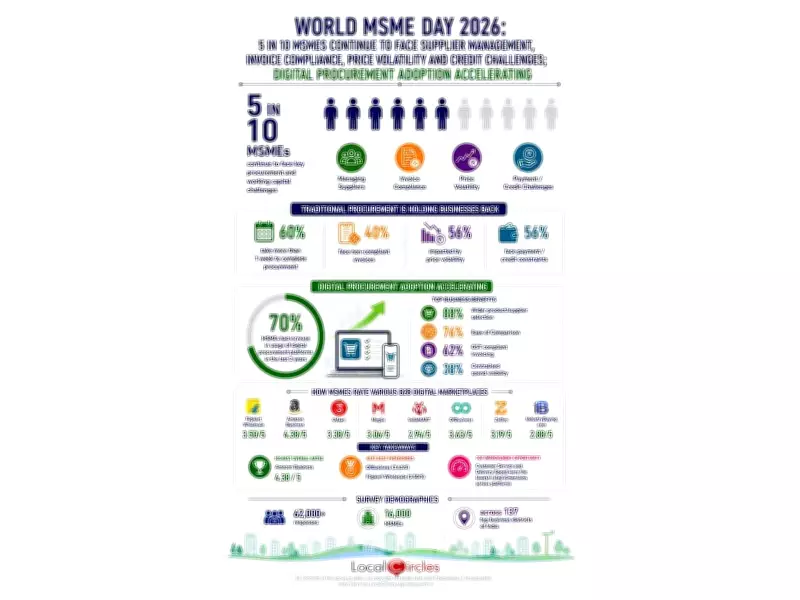
Digital procurement is rapidly moving from the margins to the mainstream for Indian MSMEs, according to a new national study by LocalCircles released on World MSME Day 2026. The study, based on responses from over 16,000 MSMEs across 137 districts, reveals that while over 5 in 10 MSMEs still face significant challenges in supplier management and invoice compliance, adoption of B2B digital marketplaces is accelerating, with 8 in 10 MSMEs expecting increased use over the next 1-2 years.
MSME Backbone of the Economy
India's 7.4 crore-plus MSMEs registered on the Udyam and Udyam Assist platforms contribute around 31% of GDP, 35.4% of manufacturing output, and nearly half of the country's exports, generating employment for over 32 crore people. For these businesses, procurement of raw materials, inventory, packaging, IT, and office supplies remains one of the largest operating expenses.
The study found that 7 in 10 MSMEs surveyed have 10 or fewer employees, confirming that the bulk of India's MSME base consists of micro businesses with lean teams. Additionally, 6 in 10 respondents were Founders, Co-Founders, or Owners, meaning the views captured largely reflect those who sign off on procurement spend.

Business Services (28%), Manufacturing (21%), and Retail & Trading/Wholesale (21%) together constitute roughly 70% of MSMEs in India, in line with the Udyam-registered base.
Procurement Frictions Near-Universal
The survey asked MSMEs about their procurement challenges, with respondents allowed to choose multiple options. Of the 4,877 respondents, 67% indicated "Managing multiple suppliers" as a challenge, 56% cited "Non-compliant invoices," 56% "Price volatility," and 56% "Payment/credit constraints." Only 11% reported "No major challenges," confirming that procurement friction is near-universal.
Over 3 in 10 MSMEs surveyed spend over INR 2 lakhs in monthly procurement, with 1 in 10 spending over INR 10 lakhs monthly. This underscores that procurement is a serious cost line requiring robust tooling.
Digital Procurement Adoption Accelerating
The study found that 7 in 10 MSMEs who use B2B digital marketplaces say their reliance has materially increased over the last 2 years, with 1 in 10 reporting their usage has more than tripled. Key drivers for adoption include wider selection of products (88%), ease of comparison across suppliers (76%), better pricing/discounts (76%), and convenience of ordering/delivery (76%). Additionally, 62% cited GST-compliant invoicing and 38% cited centralized spend visibility as key reasons.
The speed gap between digital and traditional channels is significant: 8 in 10 MSMEs using digital channels close their procurement cycle within a week, compared to only 6 in 10 MSMEs using traditional channels. Notably, not a single MSME using digital channels reported a cycle closure time beyond two weeks.
Compliance and Invoice Requirements
All MSMEs using B2B digital marketplaces said GST-compliant invoices are most critical, and over 7 in 10 said downloadable invoice history is critical. In a related question, 7 in 10 MSMEs said the availability of GST-compliant invoicing influences their choice of marketplace. This signals that compliance and audit-readiness are now central to marketplace selection.
Future Outlook: AI and Automation
Looking ahead, 8 in 10 MSMEs expect increased use of B2B digital marketplaces over the next 1-2 years. Additionally, 61% expect increased use of AI tools/agents, and 61% expect increased automation/integration with software. Supplier diversification (50%) and greater use of credit/pay-later options (31%) are also anticipated.
B2B Digital Marketplace Ratings
LocalCircles conducted a separate rating exercise where eight major marketplaces were rated by MSMEs on a 1-5 scale across eight service categories. Amazon Business emerged as the top-rated marketplace with an overall average of 4.38 out of 5, followed by OfBusiness (3.63), Flipkart Wholesale (3.50), Udaan (3.38), Zoffco (3.19), Moglix (3.06), IndiaMART (2.94), and Industrybuying.com (2.88). Amazon Business led on Selection (a perfect 5.0), Convenience, Ease of Business Compliance, Ease of Usage, and Delivery Speed, while OfBusiness led on Value.

Customer Service and Delivery Speed were the lowest-rated categories across all marketplaces, indicating areas for improvement to drive retention and volume growth.
Macro Backdrop Supportive
The macro environment is firmly supportive of digital procurement growth. Manufacturing PMI held at 55.0 in May 2026, GST collections touched a record INR 2.43 lakh crore in April 2026, the Government e-Marketplace (GeM) has crossed INR 18.4 lakh crore in cumulative procurement, and ONDC clocked around 218 million transactions in FY26. The Union Budget 2026-27 backs the sector with a dedicated INR 10,000 crore SME Growth Fund.
According to the study, the Indian B2B e-commerce opportunity is estimated at around USD 200 billion by 2030. Public digital rails — GST, UPI, GeM, ONDC, and the MSME-TEAM onboarding push — have made the shift viable down to the smallest enterprises and smaller districts.
"The message from India's small businesses is clear: digital procurement is fast becoming mainstream, and the next phase will be about depth, intelligence and trust as much as adoption," the study concluded.