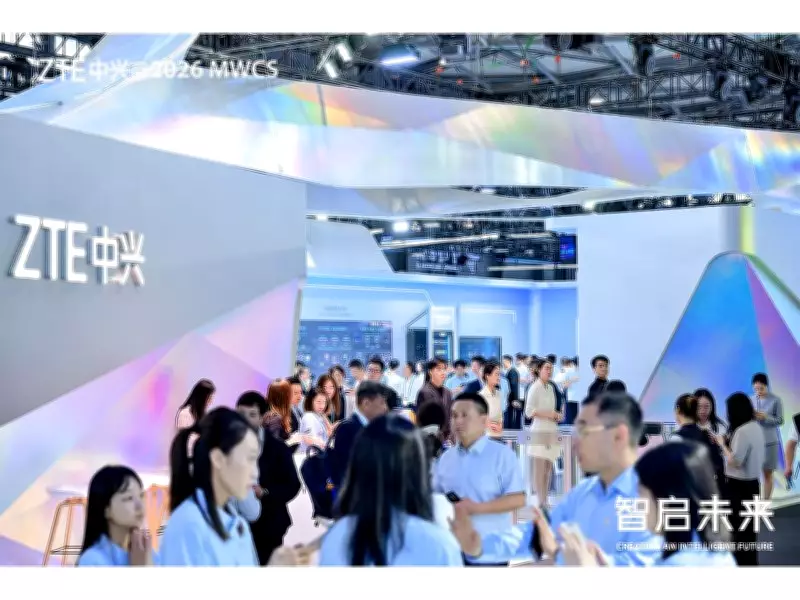
ZTE Unveils AI Factory and Token Operations at MWC Shanghai 2026
ZTE Corporation (0763.HK / 000063.SZ), a global leader in integrated information and communication technology solutions, showcased its TCO-optimal AI factory and an AIOS-powered ecosystem at MWC Shanghai 2026. The event highlighted scenario-based applications, innovative terminals, and AI-driven network breakthroughs. Through extreme synergy across computing, network, storage, energy, and software, ZTE aims to unlock new momentum for token operations.
As AI agents become widespread, industry focus has shifted from computing power scale to token efficiency. ZTE is forging a complete value chain spanning token production, services, and circulation to help operators, enterprises, and industry partners unlock AI value at scale.
TCO-Optimal AI Factory Boosts Token Production
Token efficiency is the core competitiveness in the inference era. ZTE showcased solutions that enhance token efficiency and minimize cost-per-token through deep synergy of elements like SuperPod, cost-efficient inference, and energy-efficient AIDC.

Building on 41 years of expertise, ZTE launched the SuperPod solution. It uses multi-chip open collaboration design and the Orthogonal Electrical eXchange (OEX) architecture for plug-and-play deployment. A single rack supports 128 GPUs, scalable up to 16,000 GPUs, providing a foundation for high-efficiency model training and inference.
Through network, storage, and computing synergy, ZTE achieves cost-efficient inference. Non-blocking network and Global Server Load Balancing (GSLB) enable efficient coordination across clusters of thousands to tens of thousands of GPUs, boosting overall inference efficiency.
ZTE's AIDC solution integrates 800V HVDC power supply, full-stack liquid cooling, and intelligent computing-electricity synergy for highly efficient, low-carbon operations. This shifts AI factories from compute-centric to efficiency-driven, delivering a sustainable token production system.
AIOS Platform Enables Smarter Token Scheduling
The AI factory addresses low-cost token production, while AIOS handles token scheduling, orchestration, and service-oriented output. ZTE launched the NewStart AIOS as the "technological foundation in the AI era." Built on AIOS, the Co-Claw enterprise-level agent platform integrates into ZTE terminals, extending AI services to production and daily life.
For enterprises, the focus is on enhancing office and R&D efficiency, enabling intelligent operations, self-evolving workflows, and closed-loop decision-making. For homes, ZTE launched innovative terminals with different screen sizes serving as entry points to a fully connected smart home, functioning as AI assistant, entertainment companion, and security guardian. For individuals, ZTE introduced AI-native paradigms including AI phones, AI cloud PCs, AI smart displays, and FreeScreen, enabling personalized recommendations and immersive interactions across travel, life, and work.
Leveraging AIOS, Co-Claw, and a full lineup of AI devices, ZTE transforms tokens into schedulable, serviceable, and monetizable resources, allowing operators and enterprises to develop a closed-loop model for token-based services.
AI + Network Paves Way for 6G
6G is critical infrastructure for efficient token circulation in the AI era. ZTE centers around "AI+" and "SAGIN" to speed up 6G evolution from research to commercial use. ZTE launched industry-leading LEO satellite communication payload solutions compatible with SAGIN for 5G-A and 6G, fostering connectivity for smooth evolution.
For AI-native communications, ZTE demonstrated the GigaMIMO solution and the world's first 256 TR U6G prototype. GigaMIMO leverages architecture innovation, computing synergy, and algorithmic breakthroughs to overcome bottlenecks in network capacity, coverage, and spectral efficiency, speeding up 6G deployment.
ZTE's AIR MAX solution upgrades network architecture with AI at its core, delivering a three-tier capability system: AI-native infrastructure, autonomous operations, and monetization engine. This empowers operators in capability evolution and ecosystem reshaping. The AI HI-NET solution provides AI-native, ultra-high-speed, and intrinsically secure capabilities for ubiquitous intelligent computing access and lossless wide-area connectivity.

The 10G AI-Optical Network solution is deployed across homes, campuses, and small businesses, unlocking value of all-optical cities. ZTE also promotes new calling with AI assistant, "first-class" mobile network services, ISAC for low-altitude economy, and highly autonomous networks to build a more intelligent connectivity foundation.
End-to-End Capability System for AI Era
From AI factory to AIOS, agent platform, and future networks, ZTE demonstrated an end-to-end capability system at MWC Shanghai 2026. The system covers token production, scheduling, and circulation, integrating computing, network, terminals, and agents to accelerate AI from technological breakthroughs to large-scale deployment.
The AI industry is accelerating into the inference era, where tokens have become a key measure of AI-driven value creation. Looking to the future, ZTE will work with industry partners to build more efficient, inclusive, and sustainable AI infrastructure and ecosystems, aiming to bring AI to various industries and unlock new growth momentum.