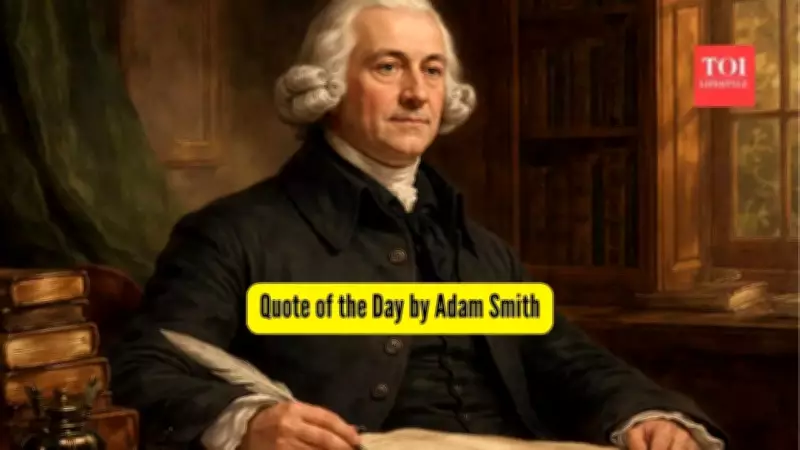
Adam Smith: The Moral Philosopher Who Shaped Modern Economics
Adam Smith stands as one of the few thinkers whose profound impact resonates deeply in the modern world. Widely hailed as the father of modern economics, Smith revolutionized our understanding of market dynamics, the significance of trade, and how individual ambition can unexpectedly benefit entire communities. However, his legacy extends far beyond economics, encompassing deep philosophical insights into morality, empathy, and societal structures.
Early Life and Formative Years
Born in 1723 in the small Scottish town of Kirkcaldy, Adam Smith's life began with adversity. His father, a customs officer, passed away before his birth, leaving his mother to raise him alone. This close maternal bond profoundly influenced Smith's character, fostering a thoughtful and introspective nature. As a child, he was known for his curiosity, thoughtfulness, and occasional forgetfulness—traits that would later become emblematic of his intellectual persona.
At the age of fourteen, Smith enrolled at the University of Glasgow, where he studied moral philosophy under the renowned philosopher Francis Hutcheson. Hutcheson's teachings on innate moral sense and empathy left a lasting impression on Smith, shaping his future philosophical work. He later attended Balliol College in Oxford, where, despite finding the academic environment uninspiring, he immersed himself in classical philosophy, history, and literature through extensive self-directed reading.

Academic Career and the Scottish Enlightenment
Upon returning to Scotland, Smith began delivering public lectures in Edinburgh and eventually secured a professorship at the University of Glasgow. There, he taught moral philosophy, covering ethics, politics, law, and economics. During this period, Smith became an integral part of the Scottish Enlightenment, a vibrant intellectual movement that included figures like David Hume. This movement championed rational inquiry, skepticism, and meticulous analysis of human society, themes that permeated Smith's lectures on justice, government, economics, and human psychology.
The Theory of Moral Sentiments
In 1759, Smith published his first major work, The Theory of Moral Sentiments. Contrary to the common perception of Smith as solely focused on self-interest, this book reveals him as a nuanced thinker. He argued that humans are not driven exclusively by selfish motives but possess sympathy—the capacity to imagine and understand others' emotions. Central to this idea is the concept of the impartial spectator, where individuals judge their actions by considering how an unbiased observer would view them. This framework suggests that morality arises from our ability to reflect on our behavior from others' perspectives, influencing philosophers, psychologists, and social theorists for centuries.
The Wealth of Nations and Economic Revolution
Smith's most famous work, An Inquiry into the Nature and Causes of the Wealth of Nations, published in 1776, transformed economic thought. Challenging the prevailing mercantilist belief that wealth stemmed from accumulating gold and restricting imports, Smith posited that true wealth derives from productive labor, trade, and specialization. His illustration of the division of labor using a pin factory demonstrated how breaking tasks into focused steps drastically boosts productivity. This insight laid the groundwork for modern economics and the Industrial Revolution.
Core Economic Principles
Smith's economic philosophy is built on several key principles:

- Free Markets: He advocated for minimal government interference, allowing individuals to trade freely, which fueled the rise of capitalism and global trade.
- Specialization: By emphasizing task division, Smith highlighted how efficiency and productivity drive societal wealth.
- Competition: He believed competition prevents monopolies, encourages innovation, and benefits consumers through better products and lower prices.
- Limited Government: While supporting reduced state intervention, Smith recognized essential governmental roles in maintaining justice and public goods.
Personal Life and Character
Despite his intellectual fame, Adam Smith led a modest and private life. He never married, remaining devoted to his mother and residing with her for most of his years. Known for his kindness, humility, and occasional absent-mindedness, Smith was described by contemporaries as thoughtful and profound. He avoided political controversies, preferring analytical discourse over public debate, and passed away in Edinburgh in 1790, leaving a legacy that endures in economics, philosophy, and policy.
Enduring Legacy
Adam Smith's ideas continue to shape contemporary thought, influencing modern economic theory, free-trade policies, industrial productivity, and debates on capitalism and regulation. His unique integration of economic insight with moral philosophy underscores that markets operate within societies of empathetic, morally conscious individuals. This holistic approach cements his status as one of history's most pivotal thinkers.
Quote of the Day: A Lesson in Self-Awareness
One of Adam Smith's most renowned quotes encapsulates his wisdom: The first thing you have to know is yourself. A man who knows himself can step outside himself and watch his own reactions like an observer. This statement emphasizes the profound importance of self-awareness and emotional intelligence. It suggests that true wisdom begins with introspection, enabling individuals to observe their emotions and behaviors objectively, rather than being controlled by them. By understanding one's strengths, weaknesses, and motivations, one gains the power to respond thoughtfully to life's challenges, making self-awareness the cornerstone of personal growth and societal harmony.