

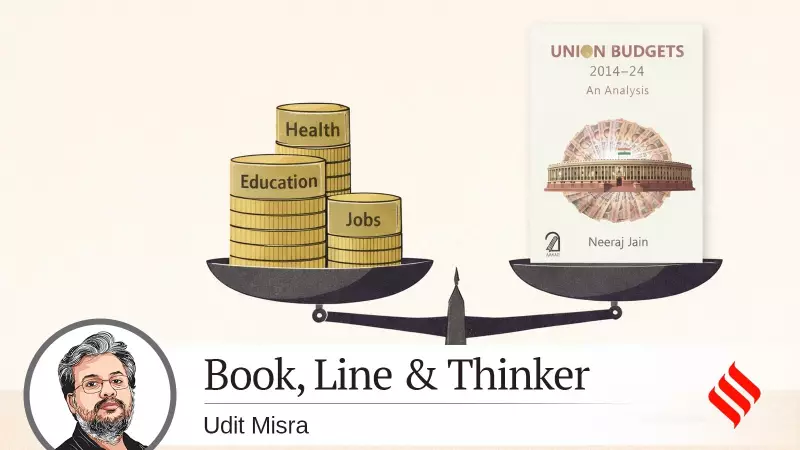
Book, Line and Thinker | A Critical Look Back at Ten Years of Modi Budgets
As the Budget season approaches, a thought-provoking new book delves into the first decade of Union Budgets under Prime Minister Narendra Modi, raising crucial questions about whether the government's proclaimed achievements match its spending patterns. Union Budgets 2014–24: An Analysis offers a detailed examination of fiscal policies from 2014 to 2024, authored by Neeraj Jain, editor of Janata Weekly and a self-described "people's economist." This analysis comes at a pivotal time, just before the NDA government presents its 13th successive full-year Budget on February 1, 2026.
The Annual Budget Cycle and Public Expectations
Each year, Union Budgets in India are met with heightened anticipation and fanfare, often fueled by hopes that the Finance Minister will unveil transformative measures to boost the economy. However, the reality frequently follows a predictable script: the government highlights its successes, while the Opposition criticizes the Budget as either economically harmful or anti-people. Amidst this political noise, most citizens quickly shift focus to personal tax implications, leaving little room for deeper discussions on critical issues like health, education, or broader fiscal strategies.
In this context, Union Budgets 2014–24: An Analysis stands out by providing a structured critique of Modi-era budgets. Despite India's complex political landscape and ongoing electoral cycles, the book argues that the government has consistently presented flawed budgets while maintaining power. It does so from a clear ideological stance, openly contrasting with the Modi administration's perspectives.

Author and Methodology
Neeraj Jain, a B Tech graduate from IIT BHU, brings a socialist lens to his analysis, relying not only on media reports but also on observations from mainstream economists who have questioned government claims. The book is organized into 18 chapters, each focusing on key areas such as education, health, agriculture, poverty, and employment, making it accessible to lay readers. Notably, it omits a chapter on defence allocations, a gap that reflects Jain's focus on social sectors rather than security spending.
Key Arguments and Findings
In the introduction, Jain asserts that when comparing official economic claims from Budgets with independent data, the discrepancies are "starling." He argues that the Modi government's priorities, as revealed in budget papers, often diverge significantly from the rhetoric in Finance Minister speeches and Economic Surveys. Jain poses fundamental questions about the government's capacity to provide free education, affordable healthcare, subsidized food, and decent pensions, answering affirmatively that it is possible, and even outlines an alternative budget proposal in the final chapter.
The analysis highlights two main issues with budget allocations during the Modi years:
- Inadequate Allocations: Spending on health and education has not only been low but has declined as a percentage of total budget outlay. For instance, health allocations dropped from 2.2% in FY15 to 1.96% in FY25, despite absolute increases. Similarly, education funding fell from 4.6% to 2.5% over the same period, and subsidies for food, fertilizer, and fuel decreased from 15% to less than 8%.
- Contradictory Interpretations: Data points touted by the government as successes are often viewed as failures by critics. A prime example is capital expenditure (capex), which the government praises for boosting infrastructure and private investment. Jain, however, contends that with the overall budget size shrinking relative to GDP, reduced revenue expenditure and insufficient total spending hinder demand growth, leaving private investments stagnant.
Ideological Divides and Data Challenges
The book's analysis is inherently shaped by its socialist ideology, which starkly opposes the Modi government's market-oriented approach. This leads to contrasting interpretations of the same data, such as viewing the privatization of Air India as either a prudent fiscal move or a giveaway of public assets. Additionally, massive data gaps, exacerbated by the lack of a 2021 Census, complicate any analysis, allowing for disagreements on underlying facts.

Jain frequently criticizes the government for treating sectors as profit opportunities for the private sector rather than providing public services directly. In contrast, the Modi administration advocates for reducing state intervention, a legacy of post-1990s economic liberalization. This ideological clash underscores the importance of readers clarifying their own perspectives before engaging with budget analyses.
Conclusion and Broader Implications
Union Budgets 2014–24: An Analysis serves as a critical tool for evaluating a decade of fiscal policy under PM Modi. It encourages readers to reflect on whether the budgets have been steps in the right direction or if a more radical, socialist shift is needed for India's economy. As Budget season returns, this book prompts a deeper conversation about spending priorities and their alignment with national needs, beyond the usual political rhetoric.





