

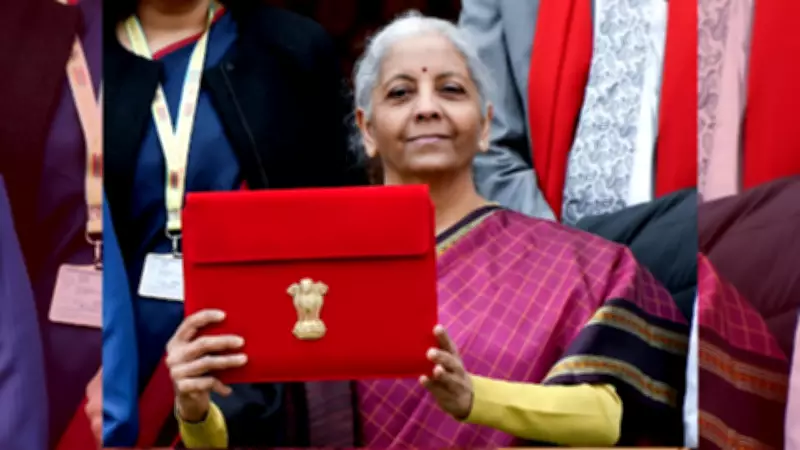
Finance Minister Nirmala Sitharaman Presents Ninth Consecutive Union Budget for 2026-27
Union Finance Minister Nirmala Sitharaman on Sunday delivered her ninth consecutive Union Budget speech in the Lok Sabha, outlining the government's comprehensive fiscal roadmap, policy priorities, and key reforms for the financial year 2026-27. Her address, lasting 1 hour and 25 minutes, covered a wide spectrum of sectors including taxation, infrastructure, financial institutions, healthcare, and social welfare, providing a detailed blueprint for India's economic growth and development in the coming year.
Budget 2026-27: Key Highlights and Fiscal Targets
The government has set a capital expenditure target for FY27 at Rs 12.2 lakh crore, continuing the momentum of public investment. This marks a significant increase from Rs 11.2 lakh crore in the Budget Estimates for 2025-26. The fiscal deficit for BE 2026-27 is estimated at 4.3 percent of GDP, down from 4.4 percent in RE 2025-26, aligning with the government's commitment to fiscal consolidation.
In her speech, Sitharaman emphasized the government's threefold kartavya (duty) approach: accelerating economic growth, fulfilling people's aspirations, and ensuring inclusive development under the vision of Sabka Sath, Sabka Vikas. She highlighted that India's economic trajectory over the past 12 years has been marked by stability, fiscal discipline, sustained growth around 7%, and moderate inflation.

Major Sectoral Announcements and Reforms
The Budget introduced several new initiatives and schemes across key sectors:
- Manufacturing and Infrastructure: Proposals include scaling up manufacturing in 7 strategic sectors, rejuvenating 200 legacy industrial clusters, and creating "Champion MSMEs" with a Rs 10,000 crore SME Growth Fund. The government also announced the development of City Economic Regions (CERs) with an allocation of Rs 5000 crore per CER over 5 years.
- Healthcare and Biotechnology: The Biopharma SHAKTI scheme with an outlay of Rs 10,000 crore over 5 years aims to develop India as a global biopharma manufacturing hub. Additionally, initiatives to upgrade AYUSH infrastructure and set up Regional Medical Hubs for medical tourism were announced.
- Agriculture and Rural Development: Schemes like Bharat-VISTAAR, an AI tool for farmers, and support for high-value crops such as coconut, cashew, and sandalwood were introduced. The government also proposed SHE-Marts to empower rural women-led enterprises.
- Technology and Innovation: Focus on emerging technologies including AI, with measures like fast-tracking Advance Pricing Agreements for IT services and tax incentives for data centers and global talent.
Taxation and Ease of Living Measures
In Part B of the Budget, Sitharaman presented proposals on direct and indirect taxes, emphasizing simplification and ease of compliance:
- The new Income Tax Act, 2025 will come into effect from April 1, 2026, with simplified rules and forms.
- TCS rates on overseas tour packages and for education/medical purposes under LRS were reduced to 2%.
- Measures to rationalize penalties and prosecution, including immunity frameworks for certain disclosures, were introduced.
- Customs duty exemptions were adjusted to support domestic manufacturing and exports, with simplifications in processes for smoother trade.
Social Welfare and Inclusivity
The Budget reaffirmed the government's focus on vulnerable sections, with schemes for Divyangjan empowerment, mental health care through new institutes like NIMHANS-2, and targeted efforts for Purvodaya States and the North-Eastern Region. Initiatives in tourism, sports under the Khelo India Mission, and heritage conservation were also highlighted to boost employment and cultural preservation.

Sitharaman concluded by commending the Budget to the House, underscoring the government's commitment to transforming India into a Viksit Bharat by 2047. The speech, delivered on Magha Purnima and the birth anniversary of Guru Ravidas, reflected a blend of traditional values and modern economic strategies, aiming to balance ambition with inclusion in India's growth journey.





