

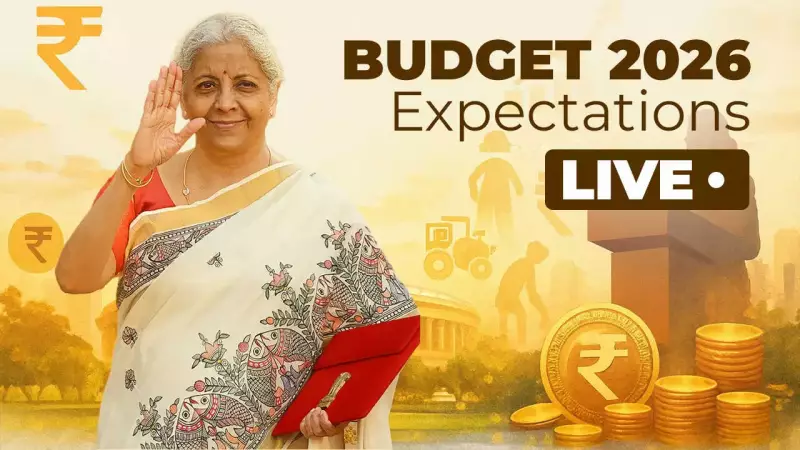
Budget 2026 Expectations: India's Economic Strategy Amid Global Headwinds
Finance Minister Nirmala Sitharaman is set to present the Union Budget 2026 on February 1, 2026, marking a significant moment as it will be delivered on a Sunday for the first time. The budget session of Parliament commences on January 28, 2026, with all eyes on how the Modi government plans to navigate increasing global economic and geopolitical challenges.
Addressing Trump's Tariffs and Export Sector Concerns
The budget assumes critical importance as India faces the impact of 50% tariffs imposed by US President Donald Trump. Economists and industry experts are keenly watching for measures to protect the Indian economy, particularly the exports sector, from these trade disruptions. The government's strategy to mitigate these effects will be a key highlight of Budget 2026.
Tax Relief and Fiscal Measures
As in previous years, salaried taxpayers are anticipating additional tax relief and simpler compliance procedures, including potential reductions in TDS and TCS. The budget is expected to balance fiscal prudence with growth-oriented policies, continuing the focus on stimulating consumption and investment.

Capital Expenditure and Infrastructure Focus
Budget 2026 is likely to maintain its emphasis on enhanced capital expenditure in infrastructure, with particular attention to:
- Roadways and highways development
- New railway lines and upgrades
- Increased defence spending amid evolving geopolitical dynamics
Economists predict the government will continue its fiscal deficit reduction efforts while supporting economic growth through strategic investments.
Industry Expectations and Expert Insights
Pradeep Gupta, Executive Director at Lighthouse Canton, emphasizes the need for continuity in measures stimulating consumption and investment. He highlights the importance of addressing US-led tariff impacts on the Indian rupee and foreign institutional investments. Key recommendations include:
- Removal of non-tariff barriers
- Greater openness to Foreign Direct Investment (FDI)
- Targeted support for export-oriented sectors
- Rehauling of capital gains tax to restore investor confidence
Akshit Bansal, Founder & CEO of Statiq, advocates for bold actions to combat urban air pollution through electric vehicle (EV) incentives. He urges reducing GST on EV charging services from 18% to 5% to make electric mobility more affordable and accelerate sustainable transportation adoption.
Nitin Gupta, Co-Founder & CEO of Attero, calls for strategic investments in critical minerals and recycling capabilities to reduce import dependence. He suggests fiscal incentives for advanced recycling technologies and rare earth processing to strengthen India's self-reliance and circular economy initiatives.
Amit Goyal, Managing Director at PMI South Asia, stresses the importance of investing in human capital for achieving Viksit Bharat goals. He recommends aggressive mid-career reskilling, AI-fluent executive education, and enhanced project management capabilities to drive national transformation.
Saket Gaurav, CMD of Elista, highlights the electronics sector's need for policy continuity and deeper support for local value addition. He emphasizes simplified tariffs, predictable incentive disbursements, and investments in skills and R&D to boost domestic manufacturing and global competitiveness.
Economic Context and Future Outlook
India, as the world's fastest-growing major economy, is on track to become the third-largest by the end of the decade. Budget 2026 will play a crucial role in shaping this trajectory by addressing immediate challenges while laying the groundwork for long-term sustainable growth. The government's ability to balance fiscal discipline with strategic investments will determine India's resilience in the face of global economic uncertainties.






