

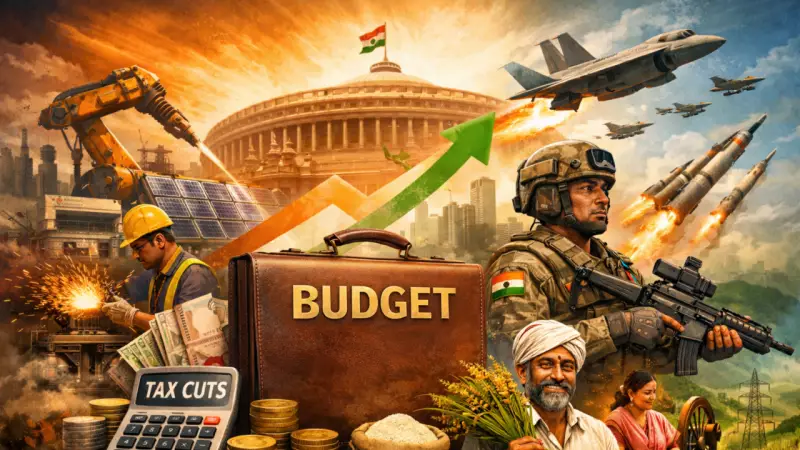
Union Budget 2026: Navigating Fiscal Priorities Amid Economic Growth
Each year, the Union Budget commands nationwide attention as it charts India's economic course for the upcoming financial year. As Finance Ministers meticulously balance tax policies, expenditure allocations, and strategic priorities, households, businesses, and policymakers across the country eagerly analyze potential gains and implications. The annual budget presentation has evolved into a crucial event that shapes economic behavior and investment decisions throughout the nation.
Tax Reforms: Evolution and Future Expectations
Over the past five fiscal years, India's taxation framework has undergone significant transformation through progressive personal tax restructuring, consistent corporate tax policies, and evolving indirect tax mechanisms. The new income tax regime introduced in 2020 has seen substantial refinements, with Budget 2023 establishing it as the default option on e-filing portals while simplifying slabs and enhancing exemptions. Budget 2024 further increased the standard deduction for salaried individuals to Rs 75,000 under this regime.
The most dramatic change arrived with Budget 2025, which made personal income up to Rs 12 lakh completely exempt under the new regime (effectively Rs 12.75 lakh for salaried taxpayers after standard deduction), substantially reducing the direct tax burden for middle-class citizens. Simultaneously, GST underwent simplification from multiple slabs to a two-tier structure of 5% and 18%, with additional levies on select luxury items.

Looking toward Budget 2026, experts anticipate further refinements rather than sweeping rate reductions. Sanjiv Malhotra, Senior Advisor at Shardul Amarchand Mangaldas, notes that while post-pandemic India experienced robust tax collections, recent GST rationalization has impacted government revenues. "GST rationalization in 2025 has hit the Government's wallet hard," he observes, suggesting that creative fund reallocation might create space for priority sector spending despite limited fiscal space.
Sumit Singhania, Partner at Deloitte India, maintains optimism about fiscal targets, noting strong direct tax collection momentum. "The fiscal deficit target for FY27 could be between 4.1 and 4.3 percent," he projects, indicating room for measured tax policy adjustments.
Infrastructure and Capital Expenditure: Sustaining Growth Momentum
Infrastructure-led capital expenditure has transformed from a counter-cyclical recovery tool to a cornerstone of India's growth strategy over recent budgets. Central capex allocations have demonstrated remarkable growth, climbing from approximately Rs 5.54 lakh crore in FY 2021-22 to surpass Rs 11 lakh crore in subsequent years, representing over 3% of GDP.
Railways have particularly benefited from sustained investment, with annual capital support reaching about Rs 2.6 lakh crore, enabling system upgrades including deployment of Vande Bharat trains, extensive electrification, and implementation of the Kavach safety system. Similarly, roads and highways have seen allocations grow substantially, supporting national highway expansion and expressway development.
As Budget 2026 approaches, the focus may shift from rapid allocation increases to improved asset utilization and project completion. Anurag Gupta, Partner at Deloitte India, emphasizes that "greater reliance on PPPs would be critical to meet ambitious investment goals" while expecting growth across social infrastructure sectors like water and sanitation.
Defense Modernization: Strategic Imperatives
Defense allocations have shown consistent growth despite broader fiscal pressures, rising from Rs 5.25 lakh crore in FY 2022-23 to approximately Rs 6.81 lakh crore in FY 2025-26. This represents nearly a 9.5% year-on-year increase, with significant portions earmarked for equipment modernization and indigenous procurement under self-reliance initiatives.
For Budget 2026, industry recommendations from FICCI suggest increasing capital outlay to 30% of the defense budget to enhance capabilities in AI-enabled warfare, UAV systems, and electronic warfare. The industry body also proposes expanding Defense Industrial Corridors and establishing a Defense Export Promotion Council to help achieve India's target of Rs 50,000 crore in defense exports by 2028-29.

Manufacturing and Subsidy Landscape
The Make in India initiative has centered increasingly on Production-Linked Incentive schemes, with Rs 1.97 lakh crore allocated across 13 sectors since 2021. These programs have generated substantial investments, production, and employment, though outcomes vary by sector. Budget 2026 is expected to focus on refining existing support mechanisms rather than introducing major new initiatives.
Subsidy allocations for food, fertilizer, and fuel have normalized following pandemic-era peaks, with Budget 2026 likely to emphasize targeted welfare delivery and efficiency improvements rather than significant expansions. Agriculture continues to receive priority attention, with expectations for continued income support, enhanced credit access, and value chain development in the upcoming budget.
Budget 2026: Balancing Growth and Fiscal Prudence
Based on emerging patterns from previous budgets, Budget 2026 is expected to continue emphasizing capital expenditure, taxpayer relief, manufacturing support, and welfare measures while maintaining fiscal discipline. As Sanjiv Malhotra suggests, defense, high-tech manufacturing, and skill development may receive increased allocations.
The upcoming budget will likely represent another balancing act between sustaining economic growth and strengthening strategic sectors through targeted investments. With infrastructure, defense, and manufacturing showing positive momentum, Budget 2026 presents an opportunity to deepen reforms while ensuring fiscal sustainability in an evolving global economic landscape.





