

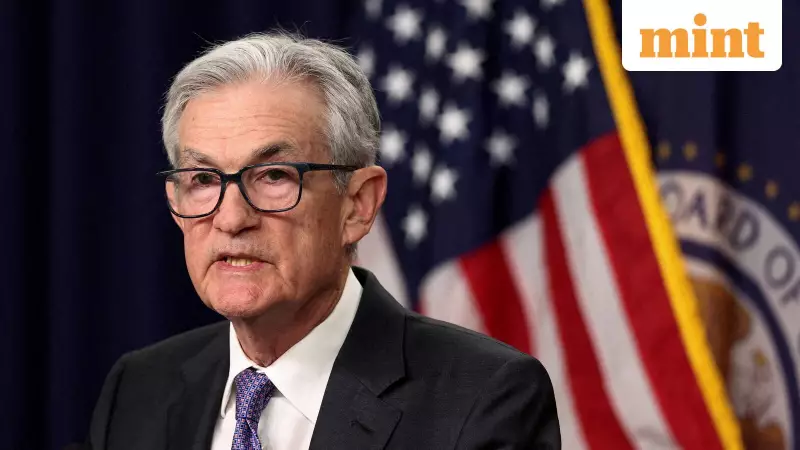
Federal Reserve Enters Holding Pattern on Rate Cuts Amid Economic Uncertainty
Federal Reserve officials are poised to halt their series of interest rate reductions this week, marking the first pause since September after three consecutive cuts. The central bank faces a complex economic landscape, with officials deeply divided over the timing and conditions necessary to resume monetary easing. This decision comes as the Fed navigates persistent inflation pressures and mounting political scrutiny from the White House.
Inflation and Labor Market Dynamics Create Policy Dilemma
The core challenge for policymakers lies in balancing two competing risks: a weakening job market versus stubborn inflation that has yet to convincingly decline toward the Fed's 2% target. Since the December meeting, neither scenario has fully materialized. Job growth has decelerated significantly, yet the unemployment rate has stabilized. Meanwhile, inflation remains elevated at approximately 2.8%, above the desired threshold, though some officials argue the underlying trend is closer to 2% when tariff effects are excluded.
This economic ambiguity has created a holding pattern within the Federal Open Market Committee. Most members still anticipate potential rate cuts later this year, but consensus on the timing remains elusive. The benchmark interest rate is expected to remain unchanged in the 3.5% to 3.75% range, with only minor adjustments to the policy statement. Language regarding "additional adjustments" will be closely watched as an indicator of the Fed's readiness for an extended pause.

Political Pressure Intensifies Amid Leadership Uncertainty
The Federal Reserve's decision-making occurs against a backdrop of extraordinary political pressure. The Justice Department has initiated a criminal investigation into Chair Jerome Powell, who characterized the probe as politically motivated to advance President Trump's agenda for lower interest rates. Simultaneously, the Supreme Court is examining whether President Trump can remove Fed Governor Lisa Cook, with several justices expressing skepticism about such authority.
Leadership transitions add another layer of complexity. President Trump's advisors suggest he is nearing an announcement for Powell's successor, whose term concludes in May. This political environment influences internal dynamics, particularly as potential candidates like Governor Christopher Waller face scrutiny over their voting alignment with presidential preferences regarding monetary policy.
Divergent Views on Inflation Measurement Complicate Consensus
Building consensus for future rate cuts requires clearer evidence of declining inflation, but officials disagree fundamentally on measurement approaches. Some policymakers, including Chair Powell, advocate for "looking through" temporary tariff impacts, viewing them as one-time price increases that distort underlying trends. By this metric, core inflation may already approximate the 2% target.
Others prioritize official inflation data, which is projected to hover near 3% through the first half of the year. Bridging this interpretative gap may require several months of additional economic indicators. Officials will monitor early-year price resets closely, particularly whether retailers, having depleted pre-tariff inventories, begin passing higher costs to consumers. Muted price adjustments could potentially remove obstacles to future rate reductions.
Labor Market Concerns and Dissenting Voices
Analysts suggest that any rate cut before mid-year would likely necessitate deterioration in labor market conditions, as inflation is unlikely to decline sufficiently to persuade skeptical officials earlier. Fed staff estimates indicate that monthly job growth, after accounting for anticipated downward revisions, might be closer to zero than official figures suggest.
Philadelphia Fed President Anna Paulson highlighted concerning sectoral concentration, noting that healthcare and social assistance accounted for nearly all net private-sector job growth last year. This uneven distribution raises questions about broader economic health.

Internal dissent is expected, particularly from Governor Stephen Miran, who has consistently advocated for more aggressive easing. Governors Michelle Bowman and Christopher Waller, expressing greater concern about labor market softness, are also viewed as potential votes for cuts. However, even with these dissents, the committee appears less fractured than in December, when disagreements spanned both directions regarding the magnitude of reductions.
The Federal Reserve's path forward remains uncertain, caught between economic data that sends mixed signals and unprecedented political interference. As officials await clearer indicators on inflation and employment, the pause in rate cuts reflects a cautious approach to navigating these turbulent waters while maintaining institutional independence.





