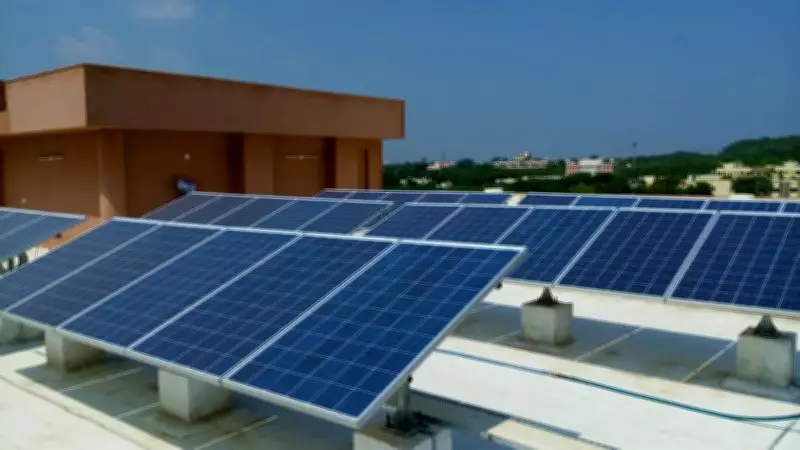
A new working paper by the Economic Advisory Council to the Prime Minister (EAC-PM) warns that India's power sector has entered a transformative phase where the primary challenge is no longer generating enough electricity, but ensuring it is available when needed. The rapid expansion of solar capacity has fundamentally altered the grid, making large-scale battery storage and adaptable grid management crucial for future energy security.
Record Demand and Price Swings Expose Grid Strain
India reached its highest-ever electricity demand of 270.8 GW on May 21. Although demand peaked in the afternoon, electricity rates did not hit their highest until after sunset, illustrating how the grid is severely strained by the decline in solar generation during evening hours. According to the paper, flexibility — the ability to quickly adjust supply as solar energy fluctuates throughout the day — has replaced generation capacity as the primary constraint on India's power system.
Two Distinct Seasonal Patterns: Duck and Camel
The study, titled “The Duck and the Camel: Tracing the Net Load on the Indian Power Grid,” analyzes grid data at 15-minute intervals and identifies two seasonal patterns. In summer, the net load — total demand minus solar generation — forms the well-known “duck curve,” marked by a sharp evening ramp as solar output falls and a deep midday dip when solar power is abundant. In winter, the grid resembles a double-humped “Bactrian camel,” with solar creating a midday trough and power demand rising in both morning and evening.

Morning Drop and Evening Ramp Intensify
The paper notes that the morning fall in conventional generation has almost tripled during the same period, while the evening ramp during summer has doubled from around 36 GW in May 2023 to about 74 GW in May 2026. This highlights that India has more electricity during the day but less after dusk.
Price Divergence and Curtailment Signal Imbalance
During sunny hours, average energy costs in the Indian Energy Exchange’s Day Ahead Market have dropped significantly, hitting as low as Rs 1.11 per unit in May 2026. In the evening, however, prices have increased to around the exchange’s Rs 10 per unit ceiling. Over the last three years, the gap between peak and trough prices has grown considerably, indicating a growing mismatch between daytime surplus and evening demand. Furthermore, because the grid could not absorb the excess renewable power, it curtailed an average of 24 GWh of solar energy every day in May 2026 — equivalent to more than 25% of Delhi’s typical daily electricity consumption.
Implications for Policy and Investment
The findings underscore the urgent need for battery storage systems that can store solar power generated during the day and release it in the evening. Without such storage, the grid will continue to waste renewable energy and face high evening prices. The EAC-PM paper calls for policy measures to incentivize storage deployment and grid flexibility, ensuring India's energy transition remains on track.